Tag: content

  • Be brave. Be specific in your copywriting

    Be brave. Be specific in your copywriting

    “Chicken!” laughs your copy accusingly as you lower your eyes from the computer in shame.

    So you type furiously in a frantic attempt to distract yourself. But even your keyboard’s in collusion. It’s rhythmic tapping marches you ever further from what your copy could’ve been.

    You’re trying to write copy that appeals to everyone, instead of copy that’s appealing to a specific group of people. Because you’re frightened of scaring away all those other potential customers that you feel like you’re excluding.

    It’s a losing battle between what’s right and what you think will pay the bills. And in evitable defeat you languish in lifeless, diluted copy that treats everyone like they’re the same.

    As every successful business person (and pious copywriter) will preach: know your customer. Find out exactly who they are and what they want. Then give it to them.

    Don’t be scared of specificity in copywriting

    When you’re marketing your new service or product, it’s only natural to feel a bit nervous. Especially when it means restricting the number of people you’ll reach before you’ve even got any.

    Cutting that number down feels like you’re reducing the amount of sales you’ll potentially win.

    Well here’s a suggestion. Don’t think of it as restricting. Think of it as concentrating. You’re making a bold statement when you focus on a specific group of people. The subtext to your message becomes:

    [quote]Hello you. I understand your specific problems, I know what it feels like. So I’ve come up with this perfect solution, just for you.[/quote]

    This isn’t a radical idea. Think about it. When you buy a premium product, you expect bespoke service. You don’t truly desire something when you know everyone else gets exactly the same treatment. People want to know they’re special. Part of a unique small group of people with exacting requirements.

    Perhaps you’re anxious because don’t know enough about your customers yet. So going after everyone feels like a more successful strategy. Well think about it this way. It’s easier to know a few things about a few people than everything about everyone. The latter is impossible and doomed to failure.

    If you’re still not convinced, a compelling side-effect of specificity is that you make your market research (and the copywriter’s) a lot quicker and more effective too.

    But … what about everyone else?!

    Don’t worry about all the other potential customers you might miss out on if you write for a specific group of people.

    Your copywriting paints such a beautiful picture of life with your product that they’ll want a piece of the action too. This other potential customer has different needs, but if you’ve written really blistering copy, they’ll talk themselves into wanting it. All because your copywriting benefits from being so focused and efficient.

    Plus, people still share common human traits. So there are bound to be overlaps between your specific group and everyone else. And there’s always the catch-all contact form where can they ask for something exceptional.

    Let them decide

    Just get your copy out there in front of people. Test it first before you decide if it works or not. Your customers are the best people to decide that.

    Note how I refer to customers as people. As soon as you shift to that way of thinking, your readers become real people with emotions to appeal to, problems to solve and dreams to believe in.

    And if your copy’s not working? Change it. That’s the beauty of tools like WordPress, things can always be updated easily in just a few clicks.

    Find out how best to serve a specific group of people. Commit yourself to them. Then prove it in your copywriting.
  • Two simple methods to improve your copywriting

    On Tuesday my head was a simmering stew of knowledge, fit to boil over and spill scorched information onto a hob of inspiration. The kitchen was a master class in promotional copywriting and head chef was Mike Kingston of OpenPage.

    Mike’s an old school consultant in marketing and he’s worked with some of British industry’s biggest behemoths. He lectures in the timeless practice of increasing sales. The gig was free thanks to Business Link Yorkshire and I drifted along with a devil-may-care what have I got to lose attitude.

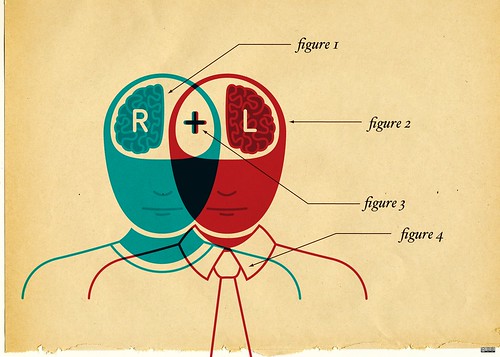
    Illustration of two people with right and left sides of the brain shown
    Brains: oversimplified. Illustration by opensourceway

    I was very pleasantly surprised. Inspired even. In fact I’d go as far as saying I almost picked up more than I could cram into my grey matter. It was one of those blissful days when you benefit from a different way of looking at things just when you thought you knew how the game worked. I’d liken it to a recent epiphany when I figured out how to make my own oven chips from only a potato and some oil. A ‘game changer’ they call it.

    I came away from the master class with some valuable new skills to add to my arsenal. Here’s two methods to help improve your copywriting that sit equally well with any creative marketing process.

    1. Avoid writer’s block: play to your brain

    Try not to go cross-eyed, but sciencey beardos propose that the brain is split (metaphorically) into two broad modes of thinking: creative and logical. In loose terms, one deals with imagination and emotion, the other with order and analysis. If you’re willing to accept this generally accepted simplification you can take advantage of either mode of thinking. Then succeed at fitting tasks and avoid creative block.

    How? It’s devastatingly simple. Don’t plan and think about how or what you need to write while you’re actually writing. One must separate the planning from the writing or you’re trying to engage both logical and creative modes of thinking at the same time. When that happens, writer’s block comes riding into town, kills the sheriff and rustles all your cattle.

    Sometimes if you’re lucky the old just write rule works. In fact there are days when I just can’t stop writing (seems to follow a day of reading). But there are others when I’m scribbling away with one hand and re-organising my copy structure with the other. That lasts a short while until I hit a brick wall. Then the voyeuristic world of Facebook beckons and Twitter seduces the fingers. Before you know it you’re LOLing at drunken photos of ur m8z.

    Guinea pig eating parsley
    Fonz Guinea pig loved his parsley. Photo by motograf

    Like your loyal guinea pig I experimented with this approach yesterday. First I planned out a structure for four client web pages and resisted the temptation to tinker with a sentence, dress up any language and play with my copy. Then I had a brain rest to savour the invigorating delights of Leeds’ ever resplendent Merrion Centre. I came back and all of a sudden – I gave birth to this article. So it seems to work for me.

    2. Take benefits to their logical conclusion: customer outcomes

    This is a great example of a different perspective on an accepted truth. Most of the marketing boffins I follow stress the importance of translating features into benefits. To give the customer what they want to know: what’s in it for me? That will always be valid. But there’s another logical progression beyond that.

    This suggests that you explore where those benefits will take the customer. It describes the state they’ll be in after they start to enjoy them. So a modern well-built (feature) car that will run reliably for many years (benefit) becomes a way to increase your sense of freedom, increase happiness in your life as you visit distant relatives and gain admiration from your colleagues as you roll up to work in it (outcomes).

    It takes benefits which are product or service focussed and transforms them into copy which is customer focussed on outcomes which are desirable: where they would like to be and where your product or service can take them.

    Working out why things work

    I’m sure there are crusty grey copywriters out there who think that these two methods are money for old rope. But I’m always on the lookout to learn and improve my copywriting. For me this was an opportunity to understand why some things work better than others. For example, I know that a well-written success story is an effective way to show a reader how a product can take them to a desirable future state. Now I know why: the story illustrates the outcomes albeit by proxy.

    Likewise I’d read about brain dominance in the past and thought it was all about separating us into creative and analytic people. But then I’ve always found it hard rationalise a background in computer science with my passion for writing and photography (both arts). I’m relieved that we can be both, just maybe not at the same time.

    Money for old rope or not. As is often the case: it’s the simplest ideas that are the best.

    Copywriters? Graphic designers? Share your thoughts

    Is writer’s block similar to creative block? Do you think the first method would work for you? And who else out there straddles the creative-analytic fence?

  • Baking a PricePie

    Baking a PricePie

    Skype really came into its own this month. I’m copywriting PricePie’s brand new web site to tell the world all about their exciting and altruistic new venture. The twist is they’re based in Southampton and we’re collaborating completely remotely. And distance isn’t presenting any obstacle to how speedily things are coming together either. In fact the home page is already up:

    PricePie clearly shows where your money goes when you pay for products and services. It’s a symbol next to a price that we’ve independently checked and verified.

    That’s the neat little two sentence strap line I wrote to quickly tell visitors what PricePie is about. It sits atop their home page above three of their service’s strongest benefits.

    Screen shot of PricePie's home page
    PricePie's home page

    Brochure web sites like PricePie’s need a home page which answers three simple questions for readers. And very quickly too:

    • Who are you?
    • What do you do?
    • Why should I do business with you?

    After all, the web site is marketing backup for all the pitches, presentations and networking the PricePie team will be doing over the next few months as they grow. Uninitiated people will find out about the web site from business cards, emails and events.

    Tailor-made copywriting

    With those three questions answered in the home page copy, the site then funnels two types of reader into tailor-made sections. Retailers are taken through three simple stages to inform, explain and turn them into partners. They are the primary audience of the site while PricePie builds its brand.

    Consumers are encouraged to take action as supporters. That’s because PricePie isn’t just a commercial service, it’s a vision for honest and ethical prices for everyone. And part of a growing ethical consumerism movement too. So to help build a community there’s Twitter and Facebook social media integration built into the site.

    I’ve planned copywriting which is highly outcome focussed. All the great things about PricePie are translated into real-world scenarios which the reader can easily understand and visualise. Here’s an excerpt explaining why a retailer should have their product verified by PricePie:

    Kerry makes an ethical and informed decision to buy your product. Instead of similar ones offered by your competitors. But it doesn’t end there. Kerry tells all her colleagues about you. She praises your honest prices and says it feels good to know money is shared responsibly and fairly. She even comes back to buy from you again in the future now that she trusts you.

    You can read more about customer focussed outcomes in my post on two simple methods for improving your copywriting.

    More to come

    There’ll be a frequently asked questions section, a blog (which they’ll write themselves) and lovely personable PricePie team biographies too. PricePie’s web site will be going live mid-late December so I’ll follow it up with another blog post then. And for those who’re interested: PricePie’s web site uses the powerful and free WordPress content management system skinned with a free theme by Mystique.

  • Animals and Mick Hucknall hang out at Listinio

    Animals and Mick Hucknall hang out at Listinio

    Listinio confirmation page with a picture of a hand giving a 'high five'
    An enthusiastic 'thank you' awaits users at Listinio

    It’s not often you get these things in the same place at once but that won’t stop me trying. And to achieve that goal I’ve joined the Listinio team as freelance copywriter to help populate their social list web app with friendly, clear and quirky copy.

    I was just about to launch into a description of what Listinio is. But I thought I’d let the copy speak for itself:

    If it’s worth recording, it’s worth sharing right? Unless it’s a top 10 of anything. Eurgh. We don’t like those. Listinio is for itemising what’s important, in no particular order and then sharing it with other people.

    Add your favourite cocktails, ingredients for a nice pie or ideas for presents. Rate other people’s lists too and spread the love. But for the love of God don’t try and add a top 10, we hate priorities.

    (Excerpt above: copywriting for a Listinio welcome message)

    Animals: a copywriter’s pets

    I played about with a few ideas (parties, animals … celebrities) and offered up two or three options for each piece of copywriting. We chose to run with a feral animal theme. The idea is that each list is like a creature born into the world by a user.

    The metaphor is continued though social media functionality. A list is free to roam about and interact with other users. Other people love and share the lists they find and you ‘feed’ lists with new information:

    Here they are!

    And don’t they all look cute? Lists are meant to live in the wild: free for everyone to love and enjoy. Select the heart button to show your love for a list.

    A list never forgets its owner too. That’s why you can always say hello to lists you’ve created and feed them new information when you drop by.

    (Excerpt above: copywriting for a Listinio landing page message)

    Mick Hucknall: a copywriter’s best friend

    I’ll be copywriting landing pages, copy for marketing emails and form/control micro-copy (feedback messages and labels). There’s also a chance to have fun with traditionally dry web pages like the HTTP 404 error (page not found). In fact that’s where you’ll find Mick Hucknall:

    Screen shot of Listinio's HTTP 404 error page with a drawing of Mick Hucknall
    Mick Hucknall gets it at Listinio

    More to come …

    Listinio is a labour of love for interface designer Paul Mackenzie and developer Michael Heap. It’s a work in progress and I’ll post a new blog entry when the Listinio web site goes live.

  • Sprucing up copy for Oblong Design Collective

    Sprucing up copy for Oblong Design Collective

    Just recently I was asked to improve some copy for the Oblong Design Collective web site which is in the process of being re-designed by one of their volunteers. Although in name the organisation sounds a bit like a chocolate bar crossed with a cybernetic race from the future, in reality they’re a charitable organisation providing a valuable design resource for their local community and other charities. I won’t dwell too much on explaining what they do – that’s sort of the point of this article…

    Their graphic designer had lifted the existing (‘old’) copy from their current web site and transplanted it into the new design proofs (fair enough – he needed something to work with). The trouble is that this old copy was a bit lifeless, unclear at times and not particularly engaging: completely at odds with the brief for the new web site.

    The brief for the new web site is to send out a clear message of what the design collective do, solicit more leads for work and encourage new volunteers to take part. Here’s a run down of how I helped improve the copy to align with that brief.

    (Disclaimer: I’m informed the designer had to type in my new copy word-by-word rather than cut and paste, so any typos are embedded in these proofs through no fault of my own.)

    Home page

    Arguably the most important pages in a web site are its landing pages and here’s their big daddy: the home page. This should answer some key questions as quickly as possible, but the existing old copy didn’t quite cut the mustard.

    Screenshot of the old Oblong Design Collective home page
    Home page with old copy
    • Mixture of passive/active voice  (“the design collective” versus “we”)
    • Landing copy doesn’t answer all three main questions efficiently: ‘who are you, what do you do and why should I do business with you’
    • Language referring to funding sounds ‘optional’ and pleading

    Improvements

    Here’s how I improved the copy by addressing the three most important questions quickly:

    Screenshot of the old Oblong Design Collective home page
    Home page with new improved copy
    • Consistent voice/tone, removing ambiguity from copy
    • All three questions answered more efficiently with inclusion of a ‘why’ playing to strengths of the design collective (“create … help … vast experience”)
    • Funding and donations made more explicit (more on this shortly)

    Services page

    Now that we’ve got our reader’s attention we need to convince them that what’s on offer is worthwhile and turn this into a lead. The old copy made an attempt at this, but in a roundabout manner.

    Screenshot of old services page
    Services page with old copy
    • ‘Train of thought’ text makes for an unclear process
    • Woolly terms (“generally … normally”) should be avoided when defining an explicit process
    • Passive tone refers to mysterious ‘clients’, rather than ‘you’ the reader
    • Services list is relegated to a side bar, a less important part of the page
    • Crucial information (“It is important …”) is lost in the body of text

    Improvements

    Here’s how I improved the copy, guiding the reader through the process and giving a call to action:

    Screenshot of old services page
    Services page with new improved copy
    • Engaging heading as bait added to draw readers in
    • List of services moved to a more prominent position at the head of the page
    • Process described more clearly in enumerated steps
    • Attention is drawn to crucial information: terms of business are now more explicit
    • Closing call to action (“Are you ready?”) indicates what to do next

    Volunteering page

    The third objective of the web site is to encourage new volunteers to join the design collective, but all the advantages were lost in dull paragraphs of the old copy.

    Screenshot of volunteering page with old copy
    Volunteering page with old copy
    • Reasons for joining aren’t clear
    • Text is in structureless continuous paragraphs
    • Vital information is lost in a jungle of sentences

    Improvements

    I improved things by concentrating on benefits (roughly two-thirds of the copy), making an overwhelming case for the reader to get involved.

    Screenshot of volunteering page with new improved copy
    Volunteering page with new improved copy
    • Soft and practical benefits are enumerated and highlighted (“support … tips and tricks”)
    • Copy given structure and broken up with lists
    • Positive language used along with a call to action (“Do you want …”)
    • Important information separated out as a ‘next step’

    Conclusion

    There are of course many ways to skin a cat, by which I mean similar ways to re-write the same copy, but the underlying goal I’ve set out to achieve is to make the copy consistent, understandable and above all a bit more engaging. I think things are looking up for the design collective’s new web site and I look forward to it going live.

  • Get your house in order first

    Graffiti on floor outside door which reads "Welcome key is under mat"
    Photograph by Alborzshawn

    With social media, it’s tempting to run straight out the front door with all guns blazing, pistol duelling with every site in the Wild West of social networking but neglecting to take care of the obvious things back home first: the humble web site.

    Hands up, when I meet a new charity client I’ve been known to get a little too excited about all the great support services, case studies and community events they have ready for me to plug using social media. It’s very easy to start telling the world all about it, but without the collateral to back up the tweets and status updates your fans and followers are just going to walk into a content black hole.

    That’s why, after I’ve taken a deep breath, I always suggest my clients invest a good amount of time in creating a reassuring body of content on their web site. This can take a while, to populate it with engaging copyriting and other media like photography and video, but it’s time well-spent. There’s also often an exercise to be done in improving usability and filling the cracks as this case study on Pizza Hut shows.

    Blogs are perfect landing pads, so I tend to point social media back to articles where people can find out more about the story that’s been tweeted, also it gives my clients time to improve their main web site which all to often seems to be managed by some legacy content management system, in-house ‘technology enthusiast’ or is little more than a static brochure. If I had my way all the time, it wouldn’t be like that but ah well …

    Remember. Social media is a powerful tool for getting your message out there and creating noise around your cause or brand. But it’s nothing without a web site full of fresh and interesting content to read that cements your values, solidifies recognition and converts a visitor to a donor or customer.