My freelance copywriting and photography business in Leeds reaches the noble age of 6 years old soon, and it’s about time this website does a better job of proudly showcasing how I help my clients.
The website before you is more cleanly laid-out and works better on mobile devices too, plus I think it looks bloody gorgeous.
When you run a small business like me, it’s tricky being bold about what you specialise in. You worry it’ll put people off offering you interesting work that might otherwise have landed your way. Yet I’ve noticed that when people see you’re capable and dedicated at one domain of work, they make the correct assumption that you’ll be able to adapt your skills to other, similar, domains.
And after hesitating for years, it’s a relief to see my website finally reflects that ambition. Here you’ll find I’ve refined my services to the three core areas you’ll see on the homepage:
Clear copy for websites (and old-fashioned print)
Insightful case studies for content marketing
Event photography in Leeds
Now I can breathe a sigh of relief asserting that decision and can get on with the most exciting part: actually doing it.
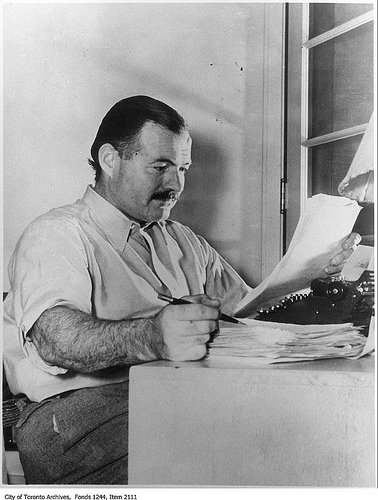
For Hemingway, it was solitude in nature, and Orwell enjoyed nothing better than catching TB in a dingy bedsit to influence his writing – throughout the ages writers share common behavioural traits that seem to define what it is to be a natural wordsmith.
You know you’re a writer when expressing yourself in the written form is an all-consuming urge. It’s inescapable – like when you ask someone graphically-minded to express complex ideas they instinctively begin to doodle; we assimilate and express our ideas in the noble sentence, albeit with a little more diligence in our scribblings. Photo by Toronto History
So here are some common traits which I’ve observed are inherent in good writers, authors and copywriters. These are intended to help you choose the right freelance copywriter for your project or perhaps nudge you in the direction of becoming a writer yourself if they resonate with your outlook on life.
Writers take things apart to understand how they work
Like humanity’s sentinels, writers watch and wonder why things are the way they are. They mentally dissect what makes people tick and turn their observations into artefacts that help people make sense of the world.
They’re obsessive about it too, immersing themselves in their arena of interest, compulsively analysing what they find with childlike fascination.
Naturally this helps writers hold a mirror up to society and lay bear the truth behind pressing issues of the day. But it also makes us perfect conduits for other people who find it harder to express themselves, or feel overwhelmed in the detail – being too close to what it is they need to write about.
Copywriters are dreamers
Fiction is the playground of writers, whether it’s creating a vivid new world in fantasy or reimagining reality were things a little different.
It’s the bedrock of empathy too – the ability to see the world through someone else’s eyes, to grasp their hopes and fears. And that puts lot of power in the hands of writers. Once you know how someone ticks you can influence them and change their minds by appealing to their core values.
This trait comes with great responsibility though, and writers haven’t always used their talent appropriately. But thankfully there are contentious copywriters out there who present the truth as they see it based on the facts. They’re driven by their underlying honesty and want to help people arrive at their own, informed conclusions.
Writing is a release for copywriters
Ask any decent writer; after observing or absorbing information and thinking it over, writing is therapeutic.
It’s cathartic, because it’s essentially a form of talking to someone about how you feel, and the reader takes the role of silent therapist in the exchange.
Good copywriters take time to consider their reader though, because it’s they who need to be persuaded or educated on the matter at hand. And when you’re writing about what you know, through research or experience, that message becomes all the more resonant.
Copywriters enjoy solitude
Sadly, this is a double-edged sword. Space to think, imagine and craft copy inevitably means isolation if you’re to concentrate on getting your copy just right. And that’s rarely healthy for a social being.
Some days, after I’ve been alone writing all day, immersed in my imagination and expressing myself to people who aren’t really there (readers I mean, not demons) my wife essentially comes home to an overgrown pet who’s been cooped up for too long in his kennel.
Yet this process of removing oneself from the world to craft a new one is the only way I know to write authentic copy, copy that’s evocative enough to change the way people perceive the one they inhabit.
Writers are walkers
It’s not all about being a tortured genius of course. Writers are also inveterate wanderers – explorers if you like. Dickens of course considered walking as much a part of his writing ritual as sharpening his pencil.
This perhaps echoes my previous point about solitude, but there’s something about the rhythmic distraction of walking that encourages ideas and inspiration to leap out at you. When the legs are free to wander, so does the mind.
In my book The Human Freelancer, I write about our preferred modes of physical relaxation being a crucial part of the creative process (using the obvious analogy of whales getting frisky). It’s the sun that germinates seeds of inspiration sown in a rich soil of research and planning.
Plus, sometimes walking away from a creative problem is the only way to gain perspective and give tectonic forces of the mind the freedom to resolve dilemmas in their own time.
So there you have it. If your freelance copywriter fits the character assessment above then you’ve gained peace of mind when you hire them. Or better still, if this all sounds like you then congratulations – you’re already a natural writer (and I’m out of a job!).
There’s a question you must always ask when you begin your copywriting. Yet troublingly, it’s a question which rarely gets a straight answer.
It’s who are you writing for?, or more broadly: which group of customers are you targeting your message at? It’s one half of a critical issue at the outset of every well-executed copywriting project, yet it applies to anyone writing anything of any consequence: what are you trying to say and who are you saying it to.
Some typical replies I’ve come across are “we’re writing for everyone who wants to buy something from us” or “we can’t decide who to write copy for so can we make it everybody?”. In both cases, the answer isn’t specific enough, at least not for this meticulous freelance copywriter.
The thing is, clients undoubtedly know their customers and how they behave, especially which ones they want more of. They’re usually just reticent to write with one specific group of them in mind, or more fundamentally, they worry about excluding other opportunities (from different customers) at the expense of focusing on that specific group.
So indecision creates a tug of war between writing good targeted copy that reaches out to and grabs the most important customers and generic copy that tries to appeal to everyone. A useful test of any decent freelance copywriter is the degree to which they fight for the former, encouraging their clients to be bold and decisive so they get better results from their copywriting.
Copywriting without direction or specificity creates copy that every client (without exception) wants to avoid: empty words that sound like what everyone else is saying. Copywriting like this not only puts off your most important customers, it also puts off everyone else because you fail to stand out. So overall, without a specific reader in mind, you have a detrimental effect on every reader.
How to avoid a copywriting stand-off
You avoid this problem by copywriting with a well-defined reader (customer) in mind. Then focus on their priorities and what keeps them awake at night. That way you write copy which truly resonates with your readers because it’s clear your product or service improves their lives.
Remember, by writing copy tailored to one group of people you aren’t sticking two fingers up at everyone else. You’re just proving you have a clear sense of identity, purpose and truly understand the impact your offering has on the people who benefit most from it. For everyone else outside of that group, commonalities will still resonate in your superbly crafted and convincing copywriting, far more than generic ‘one-size-fits-all’ copy that sounds like everyone else ever will.
It’s tricky to get copy right the first time. OK, it’s almost impossible – but when you’re writing about a complex business with lots of stakeholders, getting group consensus on things like copy style or tone of voice becomes even more elusive. Copywriting like this feels like an endless succession of conflicting revisions and disheartening edits.
This problem isn’t exclusive to copywriting of course. Mention fluid requirements and ever-changing scope to any software engineer and I guarantee the conversation will steer rapidly in the direction of development methodologies and all the benefits they offer.
Copywriting, being art more than science, doesn’t have the same lineage of formal methodologies. You simply can’t accommodate inspiration and the turbulent emotional relationship a writer has with words into a formal set of processes. Yet that said, an interesting experiment to test that hypothesis has cropped with a new client who works in IT.
My client uses the Agile software development methodology to help them handle obstacles (similar to those I described earlier) when they build systems for large organisations. And as we begin their complex new copywriting project together, the familiar issues of changing scope and elusive group consensus have reared their ugly heads. So it’s an ideal opportunity to test if copywriting can gain anything from the principles of Agile development.
I won’t bore you with the mechanics of Agile (I would’ve ten years ago when I was a developer) but it might be useful to pick out a few of its biggest benefits to help explain why this is relevant:
Agile embraces change
Simplicity, collaboration and trust are highly valued
Delivery is in frequent, small stages
It’s like a microcosm of evolution with bytes rather than life, adapting to new circumstances in a process of continual improvement. If you’re a copywriter too, I imagine you’re already as intrigued as I am at the possibilities this opens up to almost any tricky project subject to the same inevitable change.
The plan with my client is to write short sections of copy (in this case web copy for a web site) and deliver it within a period we’ve agreed. I’ve been allocated the time and budget to do that and we’ve got a set of topics we need to cover in that copy (the requirements if you will).
In principle, frequent delivery and the autonomy every freelancer loves should work well. There’s enough time to allow for the nebulous elements of copywriting (like inspiration and emotions) too, and my client clearly already believes in the Agile process.
Inside, conscientious newcomers to freelancing will be subjected to lots of well-intentioned, if often irreverent, advice from the soul of an emotionally-liberated Yorkshireman in chapters like:
What the career adviser didn’t tell you
How to survive criticism with self-esteem intact
What fluffers teach you about your job
It’s a call-to-arms for anyone who fancies making a living doing what they enjoy, and liberating more time to do the other things that keep them happy. It’s sort of like a manifesto for fulfilment, exploring everything you won’t find in other dull business self-help books.
If you fancy reading an unconventional treatise on freelancing, it’s worth every penny of its fair £5.69 price tag.
It’s the culmination of two years writing and many many more years of enlivening experience, finding my feet as an happy, honest freelancer. In it you’ll find 132 pages of insightful advice, the kind I wish someone had shared with me when I began as a freelance copywriter and event photographer in Leeds.
Self-help business books perpetuate the myth that success is relentless growth and more of everything means progress. They teach you about bookkeeping and market research – things you might need to do of course, but let’s face it they’re f**king boring.
The Human Freelancer is your antidote; stuffed full of empathy and emotional support for vulnerable newbies to self-employment like you. Whether you’re freelance, part-time, a contractor or tradesperson – read this book if you’re sensitive and brave and want to do the right thing on a happy journey of fulfilment and self-improvement. A dark sense of humour and high pain-tolerance will also maximise your reading enjoyment.
It’ll soon be available on Amazon too, where people can post their honest feedback about what they thought of The Human Freelancer.