Tag: freelance

  • Specialising

    Specialising is something you hear about when you’re a fledgling freelancer – knowing what you’re best at (and enjoy) then seeking clients who need you to do more of it.

    Yet when you’re hard-up in your formative years of freelancing you take whatever freelance work comes your way to make ends meet. Or because quite simply you’re scared to say no to anything in case you lose out.

    Now, after almost five years of freelancing as a copywriter in Leeds, I’ve transcended those formative fears. In my portfolio there are projects I’m proud of and others I’d rather put down to experience (you won’t find them here). That puts me in the privileged position of knowing what I enjoy most and what clients think I’m good at (or seem willing to pay me for).

    I’m ready to specialise

    And here’s how specific I can be about my freelance copywriting:

    • Insightful case studies: thought-provoking stories which impart advice and put my clients at the forefront of their customers’ minds in email marketing.
    • Copy for web apps: snappy copy that explains, enthuses and sells SaaS, software applications or new tech startups on websites.

    But we can go even further and specify which industries and areas these cover. I won’t promote them here because there’s a page full in my copywriting section.

    Pros and cons

    Part of me still feels nervous. Will I inadvertently exclude clients with other copywriting briefs outside those specialisms?

    Experience says no. Unusual copywriting jobs always seem to crop up despite me not actively seeking them, or having any publicly visible experience within those areas. Plus, if a job’s interesting I’ll always take a look at it.

    It seems that when people think you’re good with words they assume that means all words on any subject. Which so far holds true, it just means a bit of extra research when an unfamiliar copywriting request does come in.

    Specialising also brings a major benefit for clients. When you know a subject well, that means the process of writing about it is more efficient. That’s because I can rely on my experience and interest to propel me forward to a speedier conclusion.

    The context of specialising here simply means a decision to make a change. What that means in practical terms is I now have to present myself to the world (and its potential clients) with those specialisms, through this website, word-of-mouth and other channels.

    That’s the next challenge but at least I’m armed confidently with my experience and a clearer idea of what I’d like to help clients do more of.

  • What a great freelancer really does for you

    What a great freelancer really does for you

    This bathroom wall won’t paint itself, despite having had enough time to become self-aware, form a rudimentary appreciation of colour and evolve the appendages necessary to bathe itself in tasteful maritime tones.

    Alas, I’ve concluded that it’s time to get the professionals in. Well, almost – let’s procrastinate over another brew first.

    Paint brushes in a pot
    Photo by Ollily

    In this familiar stalemate you could substitute any other challenging project for painting which demands specialist skills and dedicated resources, including copywriting and marketing. That’s why people call in specialists like freelancers or tradesmen – when things need to get done (usually very quickly).

    Yet any decent freelancer will tell you that there’s more to solving a client’s problem than simply providing specialist skills and resources.

    What good freelancing is about

    • Renewing enthusiasm
    • Hurrying things along to completion
    • Making decisions easier
    • Organising information and tasks
    • Making things happen at the right time

    Great freelancers do this through a combination of craftsmanship, communication and delicate project management. Yet you won’t find those services explicitly advertised here on my website because I believe my clients have a right to expect those skills as part of the package.

    Empathetic freelancers are also acutely aware of the tricky stalemate I describe earlier, when a client faces up to a problem and calls the professionals in for help. That’s a brave thing to do.

    In my line of work, copywriting comes with all sorts of decisions, like who to write for, what to say and what not to say (people always want to say too much to everyone). So patience and support join the list above when my clients drag their feet or admit they’re not sure what to do next.

    Now, if only I could choose the right flavoured tea bag for this distracting brew.

  • Why decent freelance copywriters won’t charge by the word

    Why decent freelance copywriters won’t charge by the word

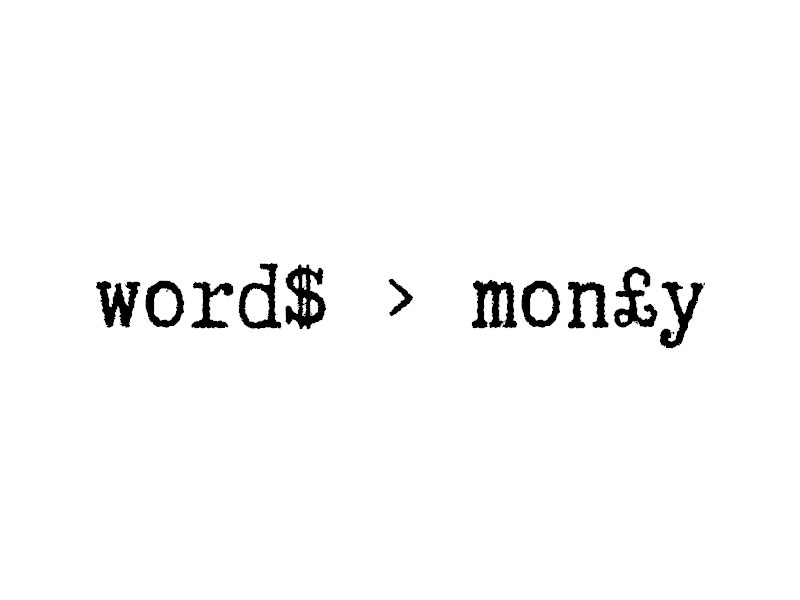
    Words are greater than money
    .

    There are unscrupulous freelance meat markets which give the impression that copywriting comes down to how many words you can afford. You’ve probably seen this sort of website; jobs are posted for freelancers to desperately bid their way to the bottom where price and quality swill about like iniquitous bin juice.

    These websites mislead clients and miss the point of what good copywriting does, as any decent freelance copywriter will tell you.

    Planning, research and a thorough analysis of what motivates your readers is what determines high quality copywriting, however long that ends up being. When clients ask me how long their copy should be I answer: as long as it takes to communicate your message and persuade a reader to do something.

    I’d rather begin with copy that’s a little too long, then distill our message until the brief is addressed in its most evocative or snappiest form. (Copywriters: let’s not get into the tiresome debate about whether long copy or short copy is best because it doesn’t matter, it’s whatever format suits the job).

    Let’s not rule out word count altogether though. Yes it’s a useful guideline if your copy must fit within the perimeter of unalterable design constraints. But it shouldn’t be the deciding factor in how much copy you need.

    If you believe budget really is the only factor that affects your project’s success then let’s work out a compromise that won’t sacrifice quality, like shrink the scope or look at photography and other mediums. Or better still, perhaps question the value you really put on carefully crafted copy that speaks honestly to your customers. Just be wary of what you’ll find on those unscrupulous meat markets because you won’t find scrupulous freelance copywriters like me there.

  • Why money for time sometimes leaves you short-changed

    Why money for time sometimes leaves you short-changed

    Each time I pay for service from a person I’ve decided to thank them for their time. That’s because no matter how much of the transaction they benefit from financially, they’ll never get back the time they gave to me.

    Palm of a hand holding coins with smiley faces on
    Photo by Materials Aart

    To me money doesn’t feel like adequate recompense for a resource as finite and precious as someone’s time.

    I pondered this conundrum while costing up an estimate for a new job recently.

    When you’re estimating how much your resources are worth, the calculation must take into account that some intangible items are tricky to put a price on.

    Value is more than the sum of the parts

    When freelancers like me work on a project we invest more than just time into it. Things like skill, passion, patience, effort and experience all contribute immeasurably to the overall quality of my finished products.

    Copywriting and photography are artistic pursuits too. So as a freelance copywriter or photographer you inevitably invest part of your soul in the copy or photos you produce. That’s why it’s sometimes saddening when our craft gets misused or altered in ways we never envisaged.

    For all this existential despair there is hope though. When a job’s successfully complete, the feeling of satisfaction from happy clients and genuinely heart-felt comments from my photographic subjects means the exchange of time becomes a much fairer deal.

  • Every freelancer’s burden: personal projects

    Every freelancer’s burden: personal projects

    An ant carries a burden of fruit while another ant looks on
    Photo by Tetsumo

    Personal (and unpaid) projects are supposed to be exciting. They’re the lifeblood of every freelancer’s creativity, they keep our skills sharp and remind us why we got into this in the first place.

    So why do so many of us never get around to them?

    When I ask other freelancers about their personal projects, they’re rarely more than ideas, on hold or simply abandoned.

    “I really ought to do more” is the oft muttered apology.

    I speak for myself too. Only recently (thanks to GTD) am I collecting all my personal project ideas in an organised way. But I still need to do something about them.

    These arrested creative intentions represent broken promises to ourselves (another GTD concept). Guilt follows inaction on these open loops and a vicious circle ensues.

    So it’s no wonder we never get around to personal projects if the consensus is to feel persistently bad for not getting around to them.

    What can we do about this?

    Here’s my attempt to convince myself and other freelancers that getting on with exciting personal projects is a worthwhile thing to do, in tip form.

    1. Treat it like a client project

      Run your intentions through the usual set of processes you would for any new project: give yourself a brief, goals and allocate time to work on it.

    2. Get things ready to go

      It’s useful to have personal projects set up and ready to go for those inevitable work famines between the feasts. So like any big challenge, break it down into smaller chunks then identify the next clear and actionable steps.

      If you’re not clear about what to do next you’ll dread even looking at it. Or fall into the trap of assuming it’s much harder than it actually is.

    3. Understand the value

      Financial motivation is important to some people so work out how much the project would cost at your usual rate. Offset that against the long-term benefits of a stronger portfolio, more experience and better skills.

      Be careful though. This could put you off, because the reward for personal projects isn’t as immediate as a paid invoice*. It’s a long-term investment that can win you new work in the future.

    Play by your own rules

    It feels counterintuitive to treat creativity and inspiration in such methodical and prescriptive ways but when you’re a hired gun with unpredictable work patterns, putting bread on the table becomes the last word for many freelancers.

    So the trick is to fit a personal project into your professional work practices and change your perception of their value.

    If all else fails, remind yourself why you went freelance in the first place: to do more of what you love on your own terms.

    And that’s exactly what personal projects are all about.

    (* = if you’re lucky enough to be a carefree artist, unbridled by capitalist conditioning then you’re already on the right track and should ignore this post aimed at lowly freelancers)

  • What the career adviser didn’t tell you

    What the career adviser didn’t tell you

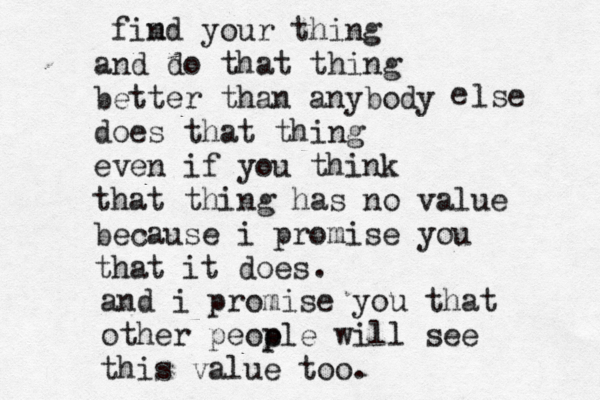
    Type written note that reads "find your thing and do that thing better than anybody else does that thing even if you think that thing has no value because I promise you that it does and I promise you that other people will see this value too
    Image via chasejarvis blog

    “That’s something the school career adviser never said to me.” My girlfriend thought aloud when she spotted this on our wall. Sadly, that’s true for many people of my generation.

    In the nineties, our education system felt like it was designed to manufacture standardised employable drones. Injection moulded breathing commodities ready to slot neatly into off-the-shelf careers.

    It continued at university too, someone who’d made it was on a fast-track graduate recruitment scheme, if they passed a battery of weird psychometric exams to test if you were subservient and malleable enough.

    I’m told the education system has changed since then. I really hope so. In a perfect world, career advisers ask questions like “what are your talents?” or better still “what makes you happy?”.

    Instead, a grey man I’d never met before took one look at my maths results and told me I’d never work in computing.

    Good job I didn’t listen

    I got my Computer Science degree, but it took another decade in corporate wilderness to free my dormant talents and find creative fulfilment as a freelance copywriter and photographer in Leeds.

    So here’s my point:

    Contrary to the career advice my generation was given at school, it’s possible to do what you love and make a living at the same time. It just needs the sort of resourcefulness, flexibility and self-belief that they don’t teach you there.