Tag: marketing

  • Top 3 reasons why you should hire a freelance copywriter

    People rarely need words alone when they hire a freelance copywriter like me. There’s always a more personal reason behind why they want to unburden themselves of a pesky marketing challenge.

    So, to make you feel less alone, if you’re a prospective client stalking me on Google, I’ll share the three main reasons why people like you have approached me to write their website copy, case studies or brochures over the last 7 years.

    1. You’ve gone native

    Maybe you’re like some of my bolder clients, and fancied having a go yourself. You know how to string a sentence together right? So, why waste money on some freelance nutter with a pencil?

    The problem is that you’re too intimately involved with the products and services that you sell day in, day out. You’ve ‘gone native’.

    That means your copy risks being focused on how you see things, rather than how your customers see things. And I personally guarantee; their priorities are very very different to yours.

    If you’re one of the few lucky folk who don’t end up banging their heads against a wall, there’s a similar pitfall to decent results which might catch you out. Your superior knowledge of your business means you’ll be overwhelmed by detail, and not know where to start.

    My professional advice? Bravely swallow your pride and hand it over to the experts. A freelance copywriter like me brings fresh eyes and experience in how to refocus your copy back on the people who are most important. I’ll help you discover things from a new angle, and emphasise everything that’s best about what you do, and why you do it.

    2. You don’t have enough time

    It’s an age old problem, so I’ll try not to bore you too much with the obvious. If you don’t have enough resources to do everything your daily duties demand, let alone all the strategic things you know you ought to be doing, then applying yourself to the fine art of crafting words that connect with people is probably bottom of your list.

    Copywriting isn’t just about sitting down and sculpting a persuasive proposition. It’s about doing your research and planning, thinking about readers’ priorities, going over your work with a beady eye, and trimming out everything superfluous so only the bare, efficient essentials are left behind in your copy.

    In this case, you probably know what to do. Pick up the phone and let me step in.

    3. You’re not so good with words

    There’s no shame in admitting that writing isn’t your thing. After all, running a successful business is probably more useful in your line of work. There’s also no shame in living with dyslexia or being better with your hands than with your mind. In fact, many clients have reached out to me for some kindly copywriting support because of both of those reasons.

    I believe that we’re all born with innate predispositions, talents if you will, and it’s our responsibility to share them with the world, by helping plug one another’ shortcomings. That way we all win, don’t we?

    To fix this one, the answer should be obvious by now. Get in touch and we’ll talk through how to make your copy really sing.
  • “People don’t buy what you do, they buy why you do it”

    “The goal is to do business with people who believe in what you believe. If you talk about what you believe, you’ll attract people who believe what you believe.”

    In this pacy video, Simon Sinek argues that people make decisions to trust others (in transactions) based on ‘why they do what they do’ (an emotional connection with values and beliefs), not the ‘what they do’ or the ‘how they do it’ (rational analysis of facts, proof and reason).

    It makes sense.

    For instance, I rewrote a lot of my freelance copywriting and photography service pages here on this website, and posted more about more rationale behind why doing what I do presses my buttons. Since then I’ve seen an increase in the number of people hiring me because they identify with that. They use words like ‘seem like a good fit’ or ‘got a lot in common’.

    And in business, the decision to work together is often swung by a face-to-face meeting where client and supplier sound one another out, and talk enthusiastically about what we enjoy about our work. It exposes common ground and mutual aspirations – where good business happens.

    That’s the ‘why you do it’ in action.

    What this means for copywriting

    In my experience, few people are lucky enough to have an in-depth, succinct understanding of what they stand for. And that’s further compounded by the pressure to articulate that in compelling, written form to readers.

    In a nutshell, this is why people hire freelance copywriters.

    First, you’d do well to first ascertain which questions (about what you stand for) your readers will be asking of you – the ones about your attitudes, values and beliefs. To quote Simon:

    “… very, very few people or organizations know why they do what they do. And by “why” I don’t mean “to make a profit.” That’s a result. It’s always a result. By “why,” I mean: What’s your purpose? What’s your cause? What’s your belief? Why does your organization exist? Why do you get out of bed in the morning? And why should anyone care?”

    To illustrate this, and continue my example above, I find that my freelance clients often wonder “will I get on with this bloke when we work together?”. So to answer that here on this website, I’ve described what it’s like when we work together countless times in my blog and published snippets of what clients say I bring to the experience.

    You can do the same in your copy by enlightening readers enthusiastically about your cause, and the reasons behind why you exist.

    Express that honestly and it’ll resonate with people who feel the same way. These are the people you should be doing business with anyway – a section of society who share a similar outlook, or face the same problems as you (that you can then solve…).

    That’s the foundation for fruitful, long-lasting trust from your followers, customers or clients.

    How to do it with copy

    There’s no doubt that copywriting is already an intimate, emotive form of communication where you can engage with your reader one-to-one. But there are some useful techniques you can supplement your copy with, which apply what we’ve learned above.

    They involve getting your values and beliefs across in contexts that the reader can identify with, framing them in clear terms that they understand, and delivering them with conviction and passion in your chosen tone of voice.

    For example:

    • Honesty comes across in candid admissions or revelations that perhaps the reader suspects or has heard about, but other people aren’t brave enough to admit
    • Legitimacy can be given by supporting your arguments with proof (case studies, accreditations, quotes from satisfied customers)
    • Permanence is conveyed by stories of your company’s legacy, and the heritage that got you where you are today

    Trust increases too when you live up to your promises, so only ever make ones that you know you can fulfil.

    Personally, I prefer to help people make informed decisions when it comes to writing your copy. I do that by laying your cards bare on the table, and I only connect emotionally if, for example, you’ve lived and breathed the same feelings and experiences that you’re suggesting your reader shares. I steer well clear of pandering to base emotions like fear or manipulating false sentiment in a reader, because it shows. When you try to pull sneaky tricks like this, these underlying motives seem to influence how you write.

    So the trick is to be honest, substantiate your claims, articulate your world-view and be clear about why you do what you do best.

    I’ll end with an excerpt from the transcript of Simon Sinek’s TED talk:

    Let me give you an example. I use Apple because they’re easy to understand and everybody gets it. If Apple were like everyone else, a marketing message from them might sound like this: “We make great computers. They’re beautifully designed, simple to use and user friendly. Want to buy one?” “Meh.” That’s how most of us communicate. That’s how most marketing and sales are done, that’s how we communicate interpersonally. We say what we do, we say how we’re different or better and we expect some sort of a behavior, a purchase, a vote, something like that.

    Here’s how Apple actually communicates. “Everything we do, we believe in challenging the status quo. We believe in thinking differently. The way we challenge the status quo is by making our products beautifully designed, simple to use and user friendly. We just happen to make great computers. Want to buy one?” Totally different, right? You’re ready to buy a computer from me. I just reversed the order of the information. What it proves to us is that people don’t buy what you do; people buy why you do it.

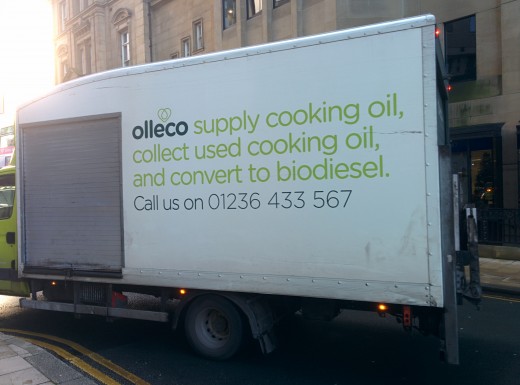
  • You know exactly where you stand with this bit of copy in Leeds

    Olleco van in Leeds city centre

    I’m struggling to find fault with this brutally clear description of Olleco’s service. I spotted their van on Infirmary Street in Leeds city centre, and hastily grabbed this photo to illustrate my point.

    OK, so the copy isn’t clever or witty but it still raised a smile – at its blatant simplicity. Often, a smart-arse approach isn’t appropriate – especially if you need to get your point across quickly and unambiguously (like on the side of a passing van for example).

    No messing about at all (unlike this shoddy notice, also spotted in Leeds in the same week).

    There’s no room for debate about what Olleco do. My only tweak would perhaps be an ‘it’ after ‘convert’, but that’s just me being a typically scrupulous copywriter.

  • Human Freelancer talks begin at Leeds universities

    Public speaking casts fear into the hearts of most people, I’d wager; myself included. I suppose it’s a primal, reflex fear of exposing yourself to danger – in this case the judgemental eyes of your peers. So why would you voluntarily do a series of five presentations to students at Leeds Universities?

    Because, like most people, once I relax and get talking I remember how much fun it is engaging with people on a subject you’re passionate about. Plus I’ve discovered some brilliant tips on how to memorise and deliver an awesome presentation (more later).

    In this case, it’s freelancing. Specifically, I’ll be discussing the principles of happy, honest freelancing, and how to do it broadly in-line with the ideology/manifesto in a book I wrote called The Human Freelancer (available on Lulu and Amazon).

    Things get off to a gentle start on 21st October at my first engagement for Leeds University’s EXPO15 event. There I’ll be on the Communications, PR & Marketing Panel taking questions from students about getting into that industry as a freelancer.

    I say gentle: it’s a bit like being on trial in Leeds University’s Rupert Becket lecture theatre. If I remember correctly (from my days as a student at Leeds University) the audience sits above and looks down on speakers, which is quite appropriate because the Human Freelancer idea has now graduated beyond the pages of the book and what’s in my head to a full-blown, public ideology for people to scrutinise.

    Will it hold firm? Let’s find out.

    After Leeds University’s EXPO event it’s on to The School of Media and Communication’s Media Futures event, then Leeds Trinity’s Employability & Enterprise week, then finally Leeds Becket University’s Kick Start your Freelance Career event.

    If that all wasn’t enough, there’s also the prospect of being on another panel at York University to promote their Freelance Challenge competition, encouraging students to turn a passion or hobby into a career.

    Get the full low-down on my guest speaking events as a freelancer in Leeds on the Human Freelancer blog.

    For brilliant tips on how to deliver a memorable presentation, check out this post on themuse.com. Tip 6 about memorising your notes is exceptionally useful.

  • What to expect when you hire me as your freelance copywriter in Leeds (in 5 easy steps)

    It’s always nice to to try before you buy, so here’s a brief description of my freelance copywriting service in Leeds, so you know what you’ll get before you hire me to write copy for your website, insightful case studies, brochure and other marketing campaigns.

    I’ve also drawn a few helpful parallels along the way for anyone looking to hire a Leeds event photographer, which is the flip side of my freelance business.

    1. A quick chat to grasp the problem or “what needs fixing and when?”

    When you call, chances are it’ll be urgent – you need your copy yesterday so there’s no time to waste. First, let’s get to the root of the problem: I’ll tell you what’s feasible and work out how to best put our heads together. That way we can make the most of this precious opportunity.

    Right now, my goal is to grasp the circumstances which lead to you picking up the phone, and to understand where this new project fits in the wider context of where you’d like to steer your business.

    2. A face-to-face meeting to explore the detail or “let’s break everything down into what needs doing”

    This is where we scope out the artefacts you need; whether that’s digital copy for a brochure website or a batch of sizzling case studies that put you front of mind with your customers. I’ll also work out a roadmap for getting copy to you on time – based on your priorities and deadlines. If you were hiring me as an event photographer this is when we’d investigate where your photos will be published – magazine, online or press, and whether you need copy space for design.

    At this point I’m beginning to immerse myself in what makes your business tick. The usual way I do this is by asking the right questions and letting you talk about what you know best, all the while frantically scribbling notes. Other information comes to light at this point too – like who has a stake in your project, who we’re trying to attract and persuade with your marketing and who else I’ll be working with on the project, like graphic designers.

    When stage 2 is done properly, I’ll leave with a notebook full of scrawl to return to my office in Headingley, Leeds and decipher it all.

    3. I plan and research or “Chris shuffles things around until they make sense”

    Any freelance copywriter worth their day rate will tell you that thorough planning and research are the pillars of compelling copy. Done properly, they can make the difference between meandering bilge, polluted with aimless waffle and streamlined copy that grabs a reader’s attention and propels them towards action.

    The process itself involves shuffling facts around, culling some and expanding upon others. I also take a look at what other industry leaders are up to, for inspiration from both their successes and failure. If you’ve hired me as your Leeds event photographer I’ll look at similar events you’ve had shot in the past, or dig some photos out of my archive to establish how you’d like your photos to look.

    By now, creative ideas are already fermenting which eventually influence the final copy. When it’s over I’ll present you with a proposed solution which we’ll discuss and refine.

    Next it’s on to the actual copywriting part.

    4. I write or “Chris locks himself in a room with a pencil”

    OK, I don’t always use a pencil – sometimes a keyboard works just as well. But what often surprises my clients in Leeds, when they hire me as their freelance copywriter, is that the process of writing only represents a relatively small part of my service. The bulk of the work is in the preparation and the creative support – distilling your problem and helping you articulate your ideas better, like I write about on my copywriting page:

    “You’re here because you need a second opinion from someone who speaks up if there’s a better way to do something, who’s fearless in the face of complexity. Someone who’ll collaborate on difficult decisions with compassion and insight, then give your project the final energetic push it needs to get out the door.”

    When I’m steeped in the facts, with new ideas and a good plan, copy tends to write itself – I just let the words flow out and refine them later. Just before those words hit the page thought, they’re mixed with my style (sometimes described as clear, educative with momentum and a strong thread). If we’ve agreed a unique tone of voice for your copywriting, that’ll also dictate the style – like wry humour, colloquial phrases or extra empathy.

    The equivalent step for my Leeds event photography would be getting behind the viewfinder and throwing myself into whatever event you’re hosting, with total creative abandon. Before you know it you’ve got several hundred useful photographs of people happily engaged in activity.

    5. You review and approve or “how can we tweak this and make it even better”

    Along the way, I’ll send you early drafts of your copy to make sure it’s along the right lines. We can do it page by page for your website, or if you need longer case studies I do you a short synopsis so it’s quicker for you to read and provide feedback.

    We’ll look at what works and what could be improved with the draft copy too. If you’d like more of one part, but less of another we’ll agree that, along with any factual tweaks. When everything has your full approval, I’ll retire to edit your copy one final time.

    At the end of my copywriting process I’ll present you with the finished product – usually shared online via Google Docs. It’ll come complete with helpful notes to guide you or your designer through layout and presentation.

    Afterwards, when your copy’s glowing online or in print and working hard to attract new custom, I’m sure you’ll want to see your face beaming out from amongst my many satisfied clients.

  • A copywriter’s job is to make sure the big ideas get understood

    My melon’s still boiling from an earlier analysis session in Leeds, dissecting the intricacies of how a client operates. Because, as always, getting to the kernels at the core of a business is an intense, all-consuming process.

    That’s when it occurred to me that my job as a copywriter in Leeds, is all about making sure the big ideas get understood.

    Maybe you’re a business in Leeds with a grand plan to revolutionise an industry with your latest development. No doubt you’re excited and your mind’s racing ahead at light speed. Well it’s my job to translate your heady passions into something that deservedly attracts attention, so that new recruits to your cause get swept up in your slipstream.

    It’s all very well getting your teeth into those zesty creative briefs every copywriter craves now and again. But unpretentious, dependable copywriters like me with an appetite for clear communication, make their living writing the stuff that’s actually useful and enduring.

    In real terms that’s persuasive words for websites, case studies for content marketing or print – words that carefully peel away the complexity of your big, juicy idea to reveal the tender, sweet fruit inside that’s impossible for customers to resist.

    After all, what good is a fresh idea if it ends up festering on a shelf, never getting the attention it deserved?