Category: Freelance life

  • Fear of freelancing

    Fear of freelancing

    A green Chameleon's head
    Image by muscapix

    [dropcap style=”font-size: 60px; color: #3A3A3A;”]M[/dropcap]y old employers and I used to have an agreement. They’d pay me money to sit in the same place five days a week and tell me what to do, and I’d moan about sitting in the same place being told what to do five days a week.

    To temporarily escape those barren grey planes of brain-haemorrhaging office tedium I’d anaesthetise myself with seemingly compulsory purchases of shiny things that I didn’t really need. Those short-lived bursts of materialistic excitement were just enough to drag me through the week to the forced joviality of ‘dress-down Fridays’. Then I had Saturday to undo the previous week’s corporate indoctrination before spending Sunday preparing for it to start all over again.

    Sounds awful doesn’t it?

    Anyone would think we didn’t have a say in the trivial matter of what we do for 250+ days a year and how we inevitably define ourselves. I accept that not everyone resents their nine-to-five salaried job, but it’s hard to ignore the barrage of Monday morning status updates along the lines of “FFS only 4 more days til Friday : (“.

    Andy Nattan’s ‘Fear of Freelancing’ post on The Professional Copywriters’ Network opened up a few old wounds (as you might have guessed from my vitriolic opening). In his post, he wrote about three common fearful obstacles to going freelance, all of which I’ve experienced.

    That’s one fear for every year I’ve been a freelance copywriter in Leeds and it serves as a convenient (if tenuous) little segue into my thoughtful ripostes on each of those obstacles and how I try to defeat them.

    Fear for your finances

    There really is a lot of economic (and general) doom and gloom in the media, but I believe it’s what you make of it. Like now; the recession has happened already so there’s no point worrying about it. Work will always need doing, it’s just going to be harder to find. And with companies shedding in-house marketing resources and costly agency contracts, there’s room for more cost-effective and flexible freelancers to plug the gap.

    Plus, if you can survive now as a freelancer in one of the toughest financial climates of recent history, you’ll thrive when we’re in the subsequent capitalist boom. But I wouldn’t wait around for the right time to go freelance though, there won’t be one. There’s always something in the media to get depressed about.

    It’s also surprising how little money you actually need to live on, a bit of careful pruning of luxuries and a make do and mend approach. I ditched the passion for gadgets, a gym membership, eat less meat and cycle more instead of by bus and car. A big realisation is that money doesn’t equal happiness too – a profound thought that’s worthy of a separate blog post.

    “But what about paying the mortgage?” you ask. I’ve got one too. But with a little foresight, saving and relinquishing materialism it’s possible to engineer a sustainable lifestyle. It’s these prudent sacrifices that make the cool waters of success all the more sweeter when that drought of perseverance and confidence in your first freelancing year finally dissipates.

    Worried about missing the security of a guaranteed wage? Ask yourself if it really exists in a salaried position. In the past I’ve twice arrived at different jobs to be told there’s no company to work for any more and that was long before any recession and its now familiar watchwords ‘pay-freeze’ and ‘wage-cut’.

    Fear of uncertainty

    Can you correctly predict the future? I can’t and I’m pretty certain none of my old bosses could either. At least now as a freelancer I make decisions that respond to new and changing circumstances, instead of someone higher up a ladder whom I’ve never met, making choices that directly affect my life.

    As a freelancer you create your own opportunities. Yes it’s hard work and your work-stream is unpredictable, but that’s what makes it exciting. You quickly learn how to market yourself indirectly through honest word-of-mouth, and the best bit is that it’s ethical and intuitive: do a good job and don’t be a ****.

    Sounds infinitely better than depending upon an unscrupulous sales and business development department doesn’t it? It just takes time and patience to pay off – that’s the real obstacle.

    Fear of failure

    Andy is right, failure is the biggest obstacle to going freelance, and being honest – I suffer with this one too as a perfectionist (and I don’t use that term lightly either). But as humans, we’re destined to get things wrong and make mistakes, it’s an essential part of learning. It’s how you adapt, refine and get better at your chosen art.

    Failure is never as dramatic as you imagine it to be anyway. That vision of you out on the streets begging in rags is just an overly catastrophic culmination of relentless worrying. There are so many stages (and escape routes) before you end up drinking meths under a viaduct.

    In reality, failure and mistakes just bring you closer to happiness; whether that’s satisfied clients, a clearer sense of self-worth and your place in the world or simply having more of the freedom that makes freelancing such a challenging but rewarding career.

    Crush your reptile

    I don’t think we’ll ever beat fear altogether. Joseph Conrad agrees:

    [quote]… as long as [man] clings to life he cannot destroy fear; the fear, subtle, indestructible, and terrible, that pervades his being; that tinges his thoughts; that lurks in his heart; that watches on his lips the struggle of his last breath.[/quote]

    Fear is a hideous impulsive relic of our reptilian days that’s designed to keep us wary and anxious of risk. It stifles ambition and maintains the status quo – and if you carry on doing more of the same, guess what you’ll get? More of the same.

    But with steady progress and arduous battles with self-belief you can outgrow fear. And to me, freelancing and self-employment feels like a natural way to fulfil our intrinsic need for challenge, problem-solving and innovation under our own steam.

    I’ll end on this thought, perhaps hindsight for my former self; smashing my head against the man’s desk in search of sensation three long years ago. If your comfort blanket of nine-to-five salaried employment is getting a bit itchy, maybe it’s time to crawl out from underneath it, otherwise you’ll suffocate.

    Escape.

    Freelance. You know it’s what you were meant to do.

  • Keep it simple

    Keep it simple

    The older I get the more I believe in the old adage “keep it simple”. Not just in copywriting but with any idea or solution to fix a problem. Here’s a good example of why, spotted outside Topshop in Leeds city centre while it temporarily relocated during its refurbishment:

    Sign in the window of a closed Topshop with details of its new address
    Topshop

    I watched for a while as bemused shoppers walked warily towards the sign, read it and then tried to work out where “40-49 The Headrow” is in Leeds. Most people who live in Leeds know where the Headrow is – it’s a long shopping street that intersects the city. But who knows where number 40-49 is? I don’t and I’ve lived in Leeds for over twelve years now.

    If I was their copywriter I’d have written something like “Where Burton used to be” or perhaps “Right of this sign, go straight up the hill”. Maybe we’d include a map or a photo instead of those superfluous plugs for their online store and social networks. Or how about no copy at all, just a human being stood outside with sweeties ready to show people the way.

    As a result, I, like most of the other shoppers, just turned around and walked directly into H&M opposite to spend my money instead.

  • 3 helpful ways to handle criticism

    3 helpful ways to handle criticism

    It’s good… but it’s not quite there yet.

    It’s one of those dreaded conversations with your client. They’ve looked at the beautiful passage of copywriting you lovingly crafted after hours of research and painstaking refinement. Just when you thought you’d attained perfection they stamp all over it and leave you tugging jagged shards of criticism from your bruised pride.

    There’s no denying it’s a horrible feeling when someone criticises your work. But it’s one that copywriters, designers and other creatives alike feel at some point in their freelance career; a nauseating mixture of shame, disappointment, embarrassment or even anger.

    We seem to instinctively fear the prospect of failure in the eyes of our peers, perhaps because it’s seen as a sign of weakness or incompetence. Politicians make an art of steadfastly refuting accusations of U-turns after a change of heart, a simple misunderstanding or a genuine mistake.

    Why it hurts so much

    Honest misunderstandings and mistakes are down to poor communication. There’s a mismatch in objectives: the client wants a product to make money; you want it to be the magnum opus of your creative career. Your client’s head contains a vision of what they want and it’s your job to interpret that into something tangible. With all that tacit knowledge being transferred, there’s bound to be something lost in translation.

    It’s a problem that’s compounded in our creative industry, where the perceived quality of our output is subjective and often hostage to the wildly oscillating whims of our clients. Plus, if you do your job properly and invest your heart and soul into a job, it’s no wonder you get upset when a client wants to tinker with your masterpiece.

    How to handle criticism

    There’s no easy cure for a bruised ego, but here’s a few techniques I’ve learned for damage limitation and positive thinking.

    1. Look for positives

    Most people have manners (clients included) and dress up their criticism. Some even go as far as suggesting improvements. So ask yourself, has the client really offended you? (If the answer is ‘yes’ then do you really want this person as your client?) Chances are they’ve been gentle about it so take a deep breath and be thankful.

    After you’ve taken criticism on the chin, stop short of revisiting your work and looking for reasons to disagree with the client’s opinion. After all, their reputation stands more chance of being damaged than your pride and turning this into an argument won’t get you any closer to fixing things.

    Focus on the good that can come out of this: the final product will be better, closer to the brief and you’ll have a happier client. Be grateful that you’ve got a chance to do something about it, unlike the alternatives: your client takes their business elsewhere or worse still; they become an expert copywriter/designer and take matters into their own hands.

    2. See the big picture

    Animated spinning email symbol
    1995 just called, they want their animated GIF back

    Do you feel the criticism is unwarranted or incorrect? Time to put aside exactly what the client said and try to understand they’re really getting at. Do a little digging around, look for the root of the problem rather than concentrating on solutions. A timeless example is the client who insists their web site lacks an animated spinning email ‘@’ GIF. Why? It turns out their customers weren’t sure how to get in touch through the web site. An issue better solved with clearer microcopy and an inline contact form (both easily deployed using WordPress).

    If you sense tension or conflict, it helps to remember that this thing is bigger than both you and the client put together. It’s all about the reader, user, customer or whoever it is that consumes the product you’re building together. Whatever makes life easier and simpler for them is the right way to go.

    3. Learn and improve

    Make this an opportunity to avoid similar situations in the future. Be proactive and make a few notes on the situation to improve how you work, like:

    • Ask more questions at the start
    • Tighten up the brief and get sign-off
    • Add more review points

    Each of these help you understand what motivates your client (or fills their head full of ‘good ideas’) so you can preempt problems before they happen.

    You’re only human

    Poor communication, misunderstanding and mistakes are as human as opposable thumbs, bipedalism and short-tempers. But what really characterises us is our ability to learn from experience. So prepare for and take lessons from criticism; use it positively to grow stronger and numb the pain. That way you can carry on doing what you do best: investing your heart and soul into your work. Plus, you expected this anyway, right? That’s why you costed in a redraft…

  • Name my baby

    Name my baby

    Choosing an identity is the exciting part of starting up a new business right? Naming a baby probably isn’t much different. You pen a list of names you like or that mean something to you, then mull them over. You do a bit of research, canvass opinion from peers and even pick a colour scheme for where it’ll live: on the web or stationery.

    Kill joy

    So why have I gone and taken all the fun out of it? By over-analysing my options with assiduous scientific diligence. An approach that serves me well when I’m copywriting, but is near-enough useless in the process of decision-making.

    Baby Tamarin and adult Tamarin
    Tamarin: my favourite animal but ultimately a meaningless name for a business

    Perhaps I’m just twitchy because of what naming a business represents. It signifies more than just a moniker, it’s the foundations of a brand.

    Personally, it represents commitment to a new phase of growth but publicly it’s a chance to say something about who you are and what you do best. In only one or two words. And that’s why I’m apprehensive. Suddenly I’m forced to gulp down my own wordy medicine in tiny doses, not the comforting tonic of sizeable sentences.

    Bzzzzzz

    This week I pulled into the hard shoulder, turned off my engine and let the bee out of my bonnet. With the painful list of ideas safely hidden away we’ve time to reflect upon some helpful advice and suggestions people have kindly offered for picking the right name for a business:

    • Can you live with it a few years down the line? If your name has novelty value, is a bit too vogue or quirky, chances are you’ll grow to hate it. (See Copywriter 2000, Carpets4U or any dry cleaners named Touching Cloth).
    • What does it mean to other people? After all, they’re who you’re selling it to. It’s no good if it’s a private joke or a nickname from school. (Exception being MoonPig).
    • Does it explain what you do? Not a hard and fast rule (e.g Nike, McDonalds), but there’s a lot to be said for slipping your function in there when you’re an unknown small business.
    • What does it sound like when you say it out loud? Brilliant acid-test for copywriting too. Can it be said quickly over the phone, for example.
    • Avoid solutions in the name. Why? BECAUSE IT DOESN’T MEAN ANYTHING. (Unless you sell chemicals).
    • Don’t analyse it too much, it should just come to you: That’s the problem, they keep coming to me.
    • Is it available? Arguably this should be top of the list if you want to purchase the domain name or trademark it.

    Show and tell

    What criteria, suggestions or inspiration informed the name of your business?

  • What advice would you give to new entrepreneurs?

    In June last year I went back to school at a boot camp for entrepreneurs, to brush up on the practicalities of running a business. As well as making new like-minded friends and exploring necessary evils (tax), what really interested me were presentations from successful entrepreneurs. People who’ve already navigated the rocky road along which I now find myself hurtling.

    A talk from guest speakers Plus Minus Design got me thinking: if I was invited back years later, what would I say to fresh-faced entrepreneurs? What golden nuggets of advice could I impart to a crowd of ambitious new start-ups who choose not to adorn the shackles of salaried employment?

    So this post is pitched somewhere between catharsis and helpful advice, it’s a work in progress too. Self-employment is a steep learning curve, but thankfully it’s one that’s been surmounted by countless successful individuals, some I’ve met, some I’ve read about and whose sentiments I’ll now attempt to echo in my own words.

    Keep the faith

    Sustained belief in an idea is tough. Especially when you’re faced with others who’ve been executing it for longer than you and have a big fat portfolio of clients to prove it. It’s also easy to start doubting your abilities when comparing yourself to others, especially in creative disciplines like copywriting and photography. I’m reminded of a line from a piece of prose that’s been stuck to the back of my Aunt’s toilet door for as long as I can remember:

    “If you compare yourself with others, you may become vain or bitter, for always there will be greater and lesser persons than yourself.”

    OK, so Desiderata is a bit preachy, but the message is clear. Use the work of others not as a benchmark, but a stepping stone: the next level to strive for. It’s also important to remember that our incumbents and competitors sometimes use smoke and mirrors: they’re still human, they make mistakes and they too had to start somewhere. As long as you’re learning and pushing yourself that’s all that matters.

    Confidence is the fuel in any entrepreneur’s furnace, it’s the drive that’ll propel you through the feasts and the famines of self-employment. Plus, if you can’t be confident in your abilities and achievements then how can you expect prospective clients to be?

    Person with head in their hands
    Isolation: cabin fever sends you a bit nuts

    Avoid isolation

    Working from home is probably the most seriously underestimated challenge to the self-employed individual. During the infancy of a venture, you’re living hand to mouth and one of the easiest ways to keep overheads down is to seal yourself off from the world in the spare room. But that’s exactly what’s bad about it: you’ll be locked away from serendipitous run-ins with potential leads, the comforting buzz of a creative workplace and healthy social interactions with other humans.

    We’re social creatures, we need opinions and sanity checks from other people as well as the natural breaks provided by friendly conversations. After a long spell of working at home I was lucky enough to get a coworking hot desk at NTI Leeds but there are plenty of other business incubators in Leeds, like the Round Foundry, QU2 and The Unit for example. There are always cafés with wifi too.

    It takes time

    And how. When I’m hand-holding clients through the intricacies of social media, I begin with this quote:

    “Social media reflects real world relationship building and like real life it takes time to build trust and experience mutual benefits.”

    Getting on people’s radars takes time, patience and perseverance. There’s also something in there about if you shout loud enough and for long enough someone will eventually hear you. Networking is a real slow burner. But just when everything seems quiet, someone somewhere might be talking about your work, recommending you and everything could change with just one phone call.

    Adapting to the pace of business start-up is tough too. Especially if you’re used to having instant access to workload, colleagues and information in an employed capacity. And it’s tough too after the excitement wears off and the dust has settled. But that’s when keeping the faith really counts.

    Push your luck

    A natural successor to the previous point: fortune favours the brave. When I was a lowly cold-caller many years ago, I pretended I knew MDs to get past gatekeepers and talk to decision-makers. Of course I’d never do that now, but sometimes to get noticed you have to be a bit cheeky, force yourself upon people and pester them. Try different things, even if they defy your normal rules. Here’s a great quote I read on Twitter recently:

    “You cannot grow AND hang on to your comfort at the same time.”

    Hard work

    Since becoming a freelance copywriter I’ve worked the occasional 14 hour day quite happily. Why? Because it’s under my own steam and on my terms. There’s something deeply liberating about being your own boss. Suddenly no one is making you do anything, you choose how and when to work on the things that you enjoy the most. Sure it’s sometimes not very well-paid or even not paid at all, but everything you produce will be a creation that you can wholeheartedly put your name to.

    Be prepared for the long-haul too. Every self-employed person I’ve spoken to has told me to be in it for the long run. Some have suggested it can be a year or two of less-than-ideal work before things really take off. That’s pretty daunting if you’re faint-hearted. No wonder so many ventures fail or don’t even get off the ground at all.

    Do you have any advice?

    You’re welcome to add your own tips or tear mine apart. I’ll follow this post up with new thoughts and observations as I ride the self-employment roller-coaster. And for your home work, read the 10 Business Commandments for Entrepreneurs.

  • Rework


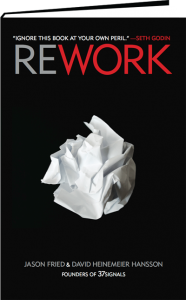
    Rework front cover
    Change the way you work forever

    Don’t you just love finding like-minded people? People who share a similar view of the world. Well, if you run a business and believe in simplicity and common sense you’ll be elated with what the people behind 37signals have to say in this book.

    Rework is a breath of fresh air through the corridors of corporate bureaucracy and traditional working practices. It’s full of simple observations about what doesn’t work in business and why we should enjoy life a bit more.

    It’s not so much a how book of tips and tricks. More a journal of lessons learned about what doesn’t work and what not to do. All peppered with frequent pokes at stiff organisations and businesspeople alike. And any copywriter will understand why that presses my buttons:

    What is it with business people trying to sound big? The stiff language… the legalese. You read this stuff and it sounds like a robot wrote it.

    It reads like a collection of blog posts. With short punchy chapters of less than three pages. That makes it easy to dip in and out of if like me you have two books on the go at once.

    I’ve only two criticisms of Rework. First, it assumes a lot of problems can be solved by a limitless supply of creativity and confidence. Characteristics we all have but in fluctuating quantities. Second, much of its premise relies on the right mix of people working together harmoniously, all with a common mindset. You know the type: free-thinking radicals who ride bikes into work and know what falafel is. People like that are a rare and special breed not often found all together.

    That aside, it’s a great read. With lessons for both freelancers and SMEs alike. Plus it even strokes the ego of good copywriters:

    …being a good writer is about more than writing. Clear writing is a sign of clear thinking. Great writers know how to communicate. They make things easy to understand. They can put themselves in someone else’s shoes.

    Right on.

    Best of all it’s a scintillating bargain on Amazon for less than seven quid. Now, if you’ll excuse me it’s almost lunch time for this freelance copywriter. And delicious chickpea based snack falafel is on the menu.