Category: Freelance life

  • Getting things done

    Getting things done

    You’re back in the office. And welcoming you is a thankless inbox full of new work waiting to be done. Yet more commitments on top of all the other ones.

    So what do you do? You attack. Armed with nothing but a flimsy task list for protection. That’s what most people do and I was no exception. When there’s so much to be done, why waste time thinking about it when you should be doing it?

    List of things to do
    .

    Yet that’s where David Allen, creator of the Getting Things Done (GTD) system, suggests the secret to better productivity lies.

    When we’re faced with seemingly endless jobs we race ahead in an attempt to get everything done as quickly possible. So we miss out the important part of stepping back to consider the bigger picture with questions like:

    • Why am I doing this?
    • What’s the best order?
    • What should I be doing where I am right now?

    GTD is a method for improving your productivity. The basic premise is that humans have single-task brains not suited to juggling the multiple concurrent demands that this information age makes of us.

    In GTD every incomplete commitment represents an open loop in our overstretched and order-seeking mind. And that causes us anxiety because your brain worries about how and when it will complete these (misconceived) equally important tasks in an uncertain future.

    What GTD means in practice

    Like any methodology that prescribes how to live your life, I treated GTD with caution. Yet after my usual introspective digestion I gained some pretty helpful new working practices.

    For example, Evernote became my trusted system – a place where I safely dump my to-do items, email actions and ideas. That way they’re somewhere accessible yet not occupying valuable processing power in my fallible human brain. It’s comforting to know that when I post a raw unprocessed task in there I don’t need to worry about it until later.

    When later arrives it’s probably time for a daily or weekly review. Yet this is what most people skip because feels like counterintuitive work about work. This is when you decide what you do now and at some time in the near and distant future.

    A review is just a more orderly way to pose those questions that you already ask yourself. Like:

    [quote]”What is the very next action that will take me closer to completing this project or goal?”[/quote]

    Sounds simple. Yet most people try and hold all that information in a brain that’s better applied to solving problems than organising them.

    By putting all your tasks into context you guarantee yourself that feeling of deep satisfaction you seek after you’ve done something. Because that something now has a clearer sense of context and purpose.

    If you ever feel overwhelmed by work and commitments leave you short of breath then I recommend you read David Allen’s book Getting Things Done. There are plenty of interesting principles you can absorb into your own routine. And you can use whichever tools you’re comfortable with (it’s not prescriptive about software or equipment).

    If you feel inspired to make a more productive change right now, then the free video tutorials over at The Secret Weapon are a good place to start.
  • Is this the simplest piece of marketing in Leeds you’ll ever see?

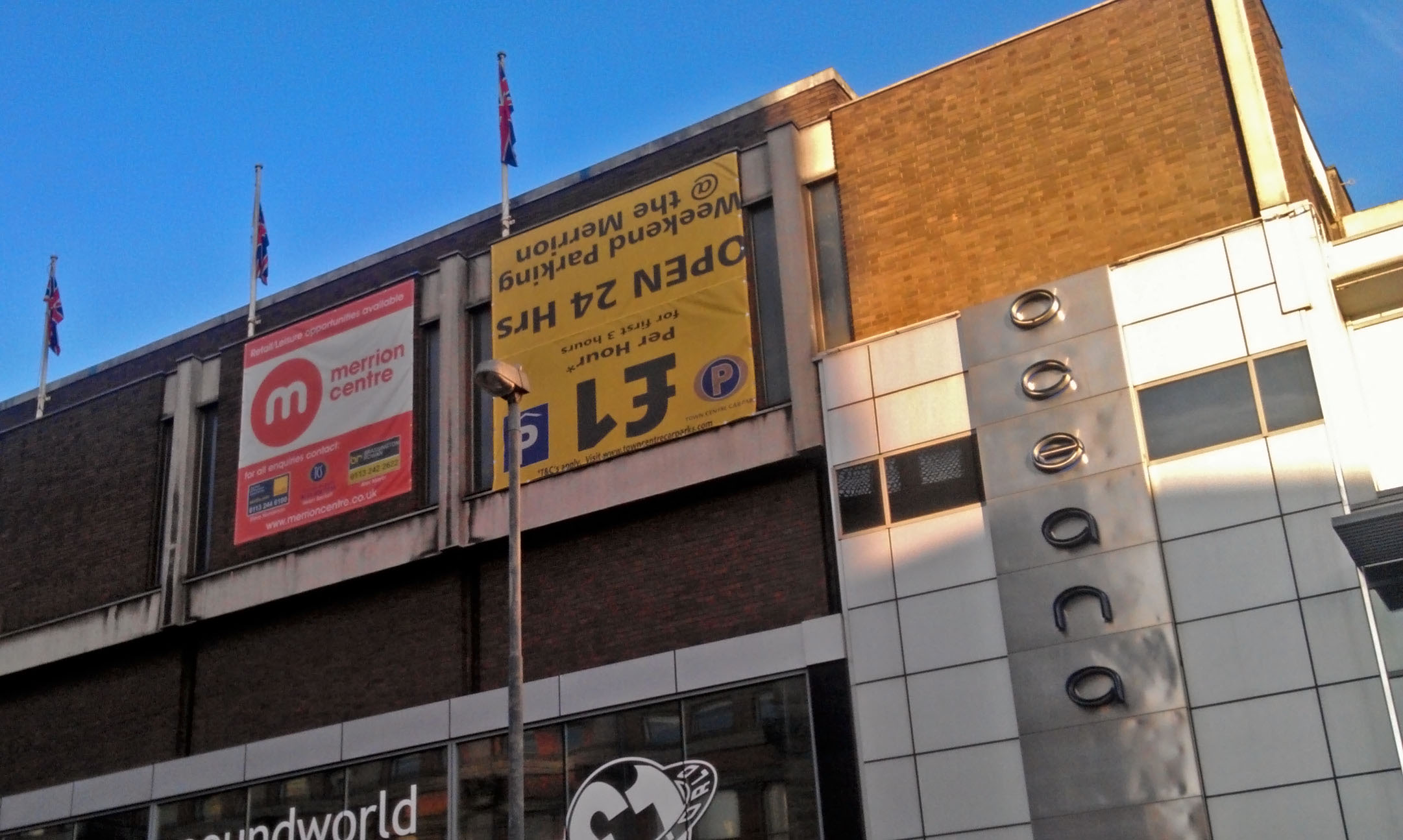
    Is this the simplest piece of marketing in Leeds you’ll ever see?

    Upside down car park advert outside the Merrion centre in Leeds
    Upside down car park advert outside the Merrion centre in Leeds

    Not because of copywriting or design. But because it’s attention-grabbing, apparently unintentional and elegantly simple.

    You can imagine people telling their friends (like I’m doing now). Or even driving in (and parking) to tell the owners about their apparent error. I even associate it with that part of Leeds. And each time I walk past the Merrion Centre I remember to look up and smile.

  • The puzzle of freelance copywriting

    The puzzle of freelance copywriting

    Hand piecing together a jigsaw
    Photo credit: lizadaly

    Second only to reading, a tricky jigsaw is a captivating way to glide peacefully through your vacant hours. And it was while abstracting order from the puzzling disarray of a jigsaw in France when I noticed the striking similarity between it and copywriting.

    You start with chaos

    And an uneasy feeling that some of the pieces might be missing. Yet you begin in earnest and turn over everything you find.

    Early on there are distinctive bits that you can’t resist putting together even though you know you shouldn’t dive straight in until you’ve examined the big picture.

    So you build the edges of the puzzle and work your way around, gradually forming the boundaries of your task. When that’s done you steadily build towards the detail at the centre, linking up with those juicy bits you couldn’t resist piecing together earlier.

    Patience is critical

    You have to know when to take a break before you feel dizzy from all that detail too. Or when to consult your reference points to make sure you’re on course for success.

    After you’ve had time to ruminate on the challenge you’re ready to immerse yourself once again, refreshed and eager to solve the puzzle.

    When you’re done

    The solution always looks more elegant than you anticipated at the beginning. The colours richer, the dimensions more impressive or the detail more intricate than you imagined.

  • What Hoggle and Didymuss can teach us about ethical copywriting

    What Hoggle and Didymuss can teach us about ethical copywriting

    [quote]
    SARAH: I MUST FACE HIM ALONE.

    DIDYMUS: WHY?

    HOGGLE: YES.

    SARAH: THAT’S THE WAY IT’S DONE.

    DIDYMUS: IF THAT’S THE WAY IT’S DONE, THEN THAT’S THE WAY YOU MUST DO IT.

    DIDYMUS: BUT SHOULD YOU NEED US…

    LUDO: UHRR.

    HOGGLE: SHOULD YOU NEED US…

    SARAH: I’LL CALL.[/quote]
    Shortly before David Bowie thrusts his inappropriately congested jodhpurs on recoiling viewers for one last time in 1986’s seminal family adventure film Labyrinth, a talking medieval dog and a grumpy dwarf teach freelance copywriters everywhere a valuable lesson in altruism.

    Hoggle from Labyrinth
    Hoggle from Labyrinth

    The difficult truth

    Sometimes a project doesn’t need the full services of a copywriter.

    Yet whatever reason lies behind that difficult truth (be it budget or practical) it’s our responsibility to acknowledge and support the person brave enough to ask for our honest opinion on what they should do about their copywriting problem.

    Sometimes people just need an impartial opinion about how to vanquish the troublesome goblin prince that lurks in their copy and a gentle push in the right direction.

    Afterwards, your reward is the unique inner glow that accompanies selfless generosity. And who knows, before the credits roll you might be invited back one day for an even bigger adventure.

    Footnote

    Fans of the film may spot similar personality traits between that of Hoggle and the copywriter: provides critical assistance at strategic points in the plot, occasionally grumpy but ultimately pure at heart.

  • Coworking in Berlin

    Coworking in Berlin

    It might be the 49ºC temperature, twelve-plus hours of golden sunlight and relentless Teutonic pure-filtered lager, but I really really like Berlin and its inspiring bohemian culture.

    And the experience just got a whole lot better after I remembered why I was there in the first place: to explore the rest of the known coworking universe.

    Pioneer Rich of Cirronix decamped to the outskirts of Berlin this summer, so Leo of Kensei Media and I took a week away from our coworking home at Old Broadcasting House for a busman’s holiday.

    Our first Berlin cowork experience was at Agora in Mittelweg one quiet Friday afternoon. After a bargain lunch and salad for about €5, I got on with some copywriting on their makeshift decorators’ tables as Jazz music drifted lazily from the cafe below.

    [tabs slidertype=”images” auto=”no” autospeed=”4000″]
    [imagetab width=”500″ height=”350″] http://www.chriskenworthy.co.uk/wp-content/uploads/2012/08/agora-cafe.jpg [/imagetab]
    [imagetab width=”500″ height=”350″] http://www.chriskenworthy.co.uk/wp-content/uploads/2012/08/agora-coworking-2.jpg [/imagetab]
    [imagetab width=”500″ height=”350″] http://www.chriskenworthy.co.uk/wp-content/uploads/2012/08/agora-desk.jpg [/imagetab]
    [imagetab width=”500″ height=”350″] http://www.chriskenworthy.co.uk/wp-content/uploads/2012/08/agora-me.jpg [/imagetab]
    [/tabs]

    Shabby-chic is the watchword at Agora, plain walls are adorned with guerrilla artwork overlooking vintage furniture and lights. Agora’s rough edges and informality reflects the idea that coworking is more about people and their chance encounters in an environment free from the suffocations of office tradition.

    The heart of Agora’s coworking space is undoubtedly its cafe area where coworkers, staff and visitors chat casually over lunch. Rich noted that many of us already make a point of eating together at Old Broadcasting House, albeit unintentionally, which made me realise just how important eating is for communal bonding.

    Later in the week we had a day at Nest coworking in Kreuzberg, a collection of first-floor spaces above a street cafe opposite Görlitzer park. Decor was even rougher at the edges, with plaster-less walls, exposed masonry and bare floorboards. If it weren’t for the smart office furniture dotted about you’d be forgiven for thinking it a squat.

    Nest was still a peaceful, bright and airy space to work and its simple style underlined that you don’t need clean white walls and flawless lines in a place of work. If anything, I craved more of Agora’s haphazardly sprinkled bric-a-brac to add character to the place in preference to Nest’s unremarkable stock office desks and chairs.

    [tabs slidertype=”images” auto=”no” autospeed=”4000″]
    [imagetab width=”500″ height=”350″] http://www.chriskenworthy.co.uk/wp-content/uploads/2012/08/nest-corridor.jpg [/imagetab]
    [imagetab width=”500″ height=”350″] http://www.chriskenworthy.co.uk/wp-content/uploads/2012/08/nest-coworking-1.jpg [/imagetab]
    [imagetab width=”500″ height=”350″] http://www.chriskenworthy.co.uk/wp-content/uploads/2012/08/nest-coworking-2.jpg [/imagetab]
    [imagetab width=”500″ height=”350″] http://www.chriskenworthy.co.uk/wp-content/uploads/2012/08/nest-street-cafe.jpg [/imagetab]
    [/tabs]

    Nest’s cafe wasn’t quite the same centre-point as it was at Agora either. It felt more like a separate entity than somewhere you might repeatedly drift through for a casual break. Its workspaces resembled conference rooms too, instead of Agora’s wide-open spaces. I noticed that this had the effect of discouraging other people from joining you, thinking you had a monopoly over the room. Communal areas encourage people to let their guard down and mingle more too, and that’s when exciting things happen.

    The folk at Agora sounded invested in their space too. We were interviewed as part of their ongoing documentary into the evolution of the coworking space, which involved interviews with members to find out what they want from it. I got the impression that there’s a spirit of free collectivism at Agora, where ideas have a genuine chance of becoming reality.

    I’ve much to reflect upon from our coworking experience in Berlin, like how much of their coworking explosion is down to cultural enablers, liberal attitudes to work practice, economics and the obvious recent historic influences in modern Germany.

    Your thoughts below please.

  • What the career adviser didn’t tell you

    What the career adviser didn’t tell you

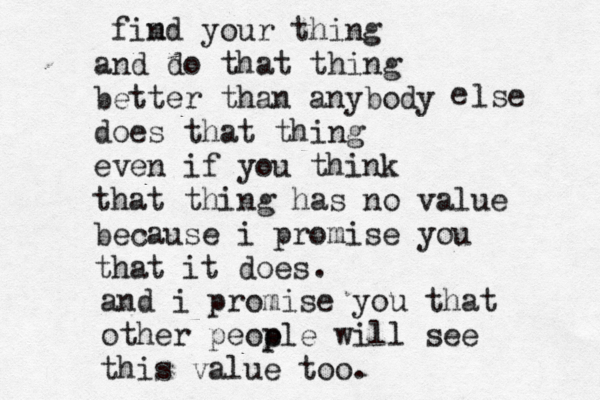
    Type written note that reads "find your thing and do that thing better than anybody else does that thing even if you think that thing has no value because I promise you that it does and I promise you that other people will see this value too
    Image via chasejarvis blog

    “That’s something the school career adviser never said to me.” My girlfriend thought aloud when she spotted this on our wall. Sadly, that’s true for many people of my generation.

    In the nineties, our education system felt like it was designed to manufacture standardised employable drones. Injection moulded breathing commodities ready to slot neatly into off-the-shelf careers.

    It continued at university too, someone who’d made it was on a fast-track graduate recruitment scheme, if they passed a battery of weird psychometric exams to test if you were subservient and malleable enough.

    I’m told the education system has changed since then. I really hope so. In a perfect world, career advisers ask questions like “what are your talents?” or better still “what makes you happy?”.

    Instead, a grey man I’d never met before took one look at my maths results and told me I’d never work in computing.

    Good job I didn’t listen

    I got my Computer Science degree, but it took another decade in corporate wilderness to free my dormant talents and find creative fulfilment as a freelance copywriter and photographer in Leeds.

    So here’s my point:

    Contrary to the career advice my generation was given at school, it’s possible to do what you love and make a living at the same time. It just needs the sort of resourcefulness, flexibility and self-belief that they don’t teach you there.