Category: Freelance life

  • Music in the clouds

    Copying files. 5 minutes remaining … Oh did I say 55? Well I meant 30. No hang on 1 hour 10 minutes. Just kidding it is definitely going to take 3 hours to transfer your music. Approximately.

    I’m hunched over, gripping my temples in desperation as Microsoft Windows tortuously nudges a lethargic progress bar across my computer screen on a hopeless crusade towards 100%.

    It’s a lazy winter Sunday: laundry’s done and legs have been stretched by a swift run. There’s little else to do now but take the bull by the horns and confront an arduous task which I’ve been avoiding for a few weeks now.

    Once again it’s time to back up my music library and transfer it to a new computer, a process any music loving techno-dweeb will be familiar with.

    Dog in front of two laptops
    Dog loved to back up his music (photo by wrumsby)

    Fastidious is the word

    Managing a comprehensive library of digital music is a labour of love, especially if you’re an ardent collector of eclectic music. My iTunes library now spans some 50GB, with over 500 albums and some 11,000 songs. Amongst my peers I’m told that’s a pretty conservative archive too.

    Each of those songs must have immaculately intact meta data. Tunes are illustrated with glorious high-resolution artwork and must be correctly categorised within an inch of its genre. I’m not obsessive about this, I just sit somewhere between perpetually discontent perfectionist and rigorously thorough.

    It was while watching Microsoft Windows’ bipolar time estimations that the reality of what I was doing dawned on me. It would only take one light-fingered house thief, a well-executed spot of arson or a biblical flood to plunge my aural fixations into a irrecoverable mire of soundless hell. Such catastrophic, albeit melodramatic, events would destroy years of autobiographic music collection.

    Slightly less devastating, but still frustrating in its own way, was the realisation that I’m encumbered with a library, the accessibility of which is defined by the amount of portable storage I can afford.

    My iPod Touch is fairly new but it restricts me to 30GB of music at any time, that’s enough for anyone you might say. But not when you get a hankering for some bizarre minimalist French electro track or a Simply Red B-side you’ve not heard in two years. Unfortunately my syncing foresight doesn’t extend to predicting musical whims before I leave the house.

    There has to be a better way

    Spotify: a better way?

    Apparently there is. Music that exists in a magical place where much of my life already resides: in the cloud.

    A friend and fellow muso rang at the weekend to gloat about his new Spotify Premium account:

    I don’t have to worry about finding music, downloading torrents and sorting out my library. I just do it all in Spotify. I can even store songs for playing offline when I’ve not got any signal on my iPhone. Do it mate.

    I’d normally admonish his smug techno eulogies, but this is the same friend who five years ago insisted I bought an iPod. Having more money than sense at the time I inquisitively purchased a sleek black 5th generation iPod photo. And consequently it changed the way I stored and played music forever. He was right then, so is he right now?

    Angels in the clouds

    Here’s some heavenly pros of moving to a paid streaming music service like Spotify premium:

    • Any track at any time: sate your lust for jazz psychedelia with Miles Davis’ in both your lugholes at 3am on a boozy Saturday morning
    • Offline music: gives me a service not dissimilar to ‘how I roll’ now
    • No faffing: gone are the days of trying to trawl for music*
    • … and the resultant finger-crossing that it’ll be of a decent pop-free quality
    • Wireless, cross-platform access to my library
    • The social layer: public profiles, sharing play lists, added irritation for people – with tweets about what I’m listening too. Very web 2.0. Very exciting.

    * = It’s probably worth mentioning that I have, on occasion, been known to download music from morally reprehensible sources. In my defence it felt like I was sticking one in the eye of monolithic gluttonous record labels by doing that and I always pay to see my favourite artists live when they play local gigs.

    In the interest of balance, here’s the side of the argument with the red light saber (cons):

    • Ownership: I’ll never really own the music, because I’m guessing it’s all DRMy in a cache somewhere. Plus, if I stop paying, I have no music
    • Service availability: very dependent on being near an Internet connection if I need that elusive track or forgot to sync before I left the house
    • Privacy: My listening habits and preferences become their property: the flip side to things like recommendations based on my listening habits
    • Money to artists: I’m not clued up on how their profits are distributed but I’m guessing margins have shrunk and the artist is the last person to get a slice of the pie
    • It’s still not ‘free’ as in ‘naughty free’: as per previous confession, probably an endemic obstacle that will always hold back paid services

    To the lions with it

    My comparisons above are by no means exhaustive and suffice to say are only loosely based on a few hours worth of quiet contemplation in the smallest room. This post is simply a reflection of the turbulent contemplation I’m giving the matter.

    With those disclaimers comfortably in place I’d like to put it to the community: Are you a user of the Spotify premium service, Last.fm or similar already? What do you make of it? Care to add anything to the pros and cons?
  • Two simple methods to improve your copywriting

    On Tuesday my head was a simmering stew of knowledge, fit to boil over and spill scorched information onto a hob of inspiration. The kitchen was a master class in promotional copywriting and head chef was Mike Kingston of OpenPage.

    Mike’s an old school consultant in marketing and he’s worked with some of British industry’s biggest behemoths. He lectures in the timeless practice of increasing sales. The gig was free thanks to Business Link Yorkshire and I drifted along with a devil-may-care what have I got to lose attitude.

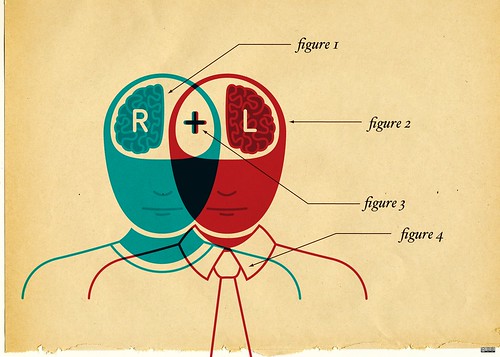
    Illustration of two people with right and left sides of the brain shown
    Brains: oversimplified. Illustration by opensourceway

    I was very pleasantly surprised. Inspired even. In fact I’d go as far as saying I almost picked up more than I could cram into my grey matter. It was one of those blissful days when you benefit from a different way of looking at things just when you thought you knew how the game worked. I’d liken it to a recent epiphany when I figured out how to make my own oven chips from only a potato and some oil. A ‘game changer’ they call it.

    I came away from the master class with some valuable new skills to add to my arsenal. Here’s two methods to help improve your copywriting that sit equally well with any creative marketing process.

    1. Avoid writer’s block: play to your brain

    Try not to go cross-eyed, but sciencey beardos propose that the brain is split (metaphorically) into two broad modes of thinking: creative and logical. In loose terms, one deals with imagination and emotion, the other with order and analysis. If you’re willing to accept this generally accepted simplification you can take advantage of either mode of thinking. Then succeed at fitting tasks and avoid creative block.

    How? It’s devastatingly simple. Don’t plan and think about how or what you need to write while you’re actually writing. One must separate the planning from the writing or you’re trying to engage both logical and creative modes of thinking at the same time. When that happens, writer’s block comes riding into town, kills the sheriff and rustles all your cattle.

    Sometimes if you’re lucky the old just write rule works. In fact there are days when I just can’t stop writing (seems to follow a day of reading). But there are others when I’m scribbling away with one hand and re-organising my copy structure with the other. That lasts a short while until I hit a brick wall. Then the voyeuristic world of Facebook beckons and Twitter seduces the fingers. Before you know it you’re LOLing at drunken photos of ur m8z.

    Guinea pig eating parsley
    Fonz Guinea pig loved his parsley. Photo by motograf

    Like your loyal guinea pig I experimented with this approach yesterday. First I planned out a structure for four client web pages and resisted the temptation to tinker with a sentence, dress up any language and play with my copy. Then I had a brain rest to savour the invigorating delights of Leeds’ ever resplendent Merrion Centre. I came back and all of a sudden – I gave birth to this article. So it seems to work for me.

    2. Take benefits to their logical conclusion: customer outcomes

    This is a great example of a different perspective on an accepted truth. Most of the marketing boffins I follow stress the importance of translating features into benefits. To give the customer what they want to know: what’s in it for me? That will always be valid. But there’s another logical progression beyond that.

    This suggests that you explore where those benefits will take the customer. It describes the state they’ll be in after they start to enjoy them. So a modern well-built (feature) car that will run reliably for many years (benefit) becomes a way to increase your sense of freedom, increase happiness in your life as you visit distant relatives and gain admiration from your colleagues as you roll up to work in it (outcomes).

    It takes benefits which are product or service focussed and transforms them into copy which is customer focussed on outcomes which are desirable: where they would like to be and where your product or service can take them.

    Working out why things work

    I’m sure there are crusty grey copywriters out there who think that these two methods are money for old rope. But I’m always on the lookout to learn and improve my copywriting. For me this was an opportunity to understand why some things work better than others. For example, I know that a well-written success story is an effective way to show a reader how a product can take them to a desirable future state. Now I know why: the story illustrates the outcomes albeit by proxy.

    Likewise I’d read about brain dominance in the past and thought it was all about separating us into creative and analytic people. But then I’ve always found it hard rationalise a background in computer science with my passion for writing and photography (both arts). I’m relieved that we can be both, just maybe not at the same time.

    Money for old rope or not. As is often the case: it’s the simplest ideas that are the best.

    Copywriters? Graphic designers? Share your thoughts

    Is writer’s block similar to creative block? Do you think the first method would work for you? And who else out there straddles the creative-analytic fence?

  • Bad language: it’s always a sign

    Bad language: it’s always a sign

    I’ve just had a guest blog post published by Mortimer Chadwick Gray, a public relations company based in Leeds and London. They invite guest bloggers and copywriters like myself to contribute articles on subjects like photography, marketing, food, PR and language.

    Public sign in a park in Chapel Allerton, Leeds. It reads "The riding of motor cycles and horses or the playing of golf strokes is strictly prohibited on this land"
    Poorly written public sign in a park in Chapel Allerton, Leeds

    I chose the latter and penned a light-hearted tongue-in-cheek rant aimed squarely at poorly written public signs. It’s a subject close to my heart since attending a copywriting course run by the Plain English Campaign. Why obfuscate a public sign in incomprehensible gibberish that has just one objective: to be understood?

    Grrr. My blood is boiling again so I’ll take a deep breath and let you read the full Bad Language: it’s always a sign article at Mortimer Chadwick Gray’s blog. Alternatively you can download the article as a PDF file.

    Judge for yourself: pedantry or point valid?

  • New business address

    Old Broadcasting House Leeds
    Old Broadcasting House (Photo by Mtaylor848)

    It’s with great pleasure (and relief) that I can announce I’ve finally got my cheeks behind a hot desk in Leeds city centre at Old Broadcasting House. This refurbished historic building was once the base of BBC Yorkshire before they moved on to their new larger home, hence the name.

    NTI Leeds run the hot desk facilities at Old Broadcasting House, technically known as a ‘coworking space’ where creative freelancers and entrepreneurs come together in a shared atmosphere of innovation and cooperative knowledge sharing. My new base has also been rated in a top 10 of co-working spaces in the UK.

    It feels good to be surrounded by the buzz of other individuals in similar spheres of work in the digital sector: graphic designers, new media experts and web gurus. For the past few months my base has flitted between client sites and working from home. While the former will continue, the latter comes with it’s own unique challenges like biscuits, needy cats and mandatory solitude. It also feels much cooler to be in a white-washed period room surrounded by the reassuring matt silver sheen of Apple iMacs.

    Cards and presents are gratefully received at my new business address as shown on the contact page.

  • How a blog helps your charity

    How a blog helps your charity

    It’s time to turn the spotlight on one of my charity clients: Orb Community Arts in Knaresborough. I spend a few hours on-site per week, copywriting interviews, writing about upcoming events and making exciting announcements to the Orb community from their creative musicians and artists then putting it all together on the Orb Community Arts blog.

    So it’s time to share some of the benefits that blog copwriting support can offer to a charity after only a couple of months.

    Interview with Leon from Orb Community Arts

    The Orb Community Arts blog has been up for almost two months now telling the world all about the great community work that Orb does, are you starting to see the benefits yet?

    Absolutely. Having the blog element to the web-site has given it a very personal feel. Web pages can look great but often they’re just a repository for information and not somewhere you often return to. With the interactivity and constantly evolving nature of the blog, we’ve found more people taking notice of the web-site, an increasing number of enquiries and a lot of positive feedback. Having up to date articles on the people involved at Orb and the wide variety of stuff that goes on here seems to have succeeded in establishing a much friendlier, more approachable digital presence in a very short space of time.

    A screenshot of the Orb Community Arts charity blog
    Orb Community Arts charity blog

    Does having someone come in and create blog stories on your behalf make life easier for Orb?

    Yes. With any charity there is always more work than hours in the day. Finding time to highlight the work we do and promote it to prospective service users and partners is difficult and often gets pushed to the bottom of the agenda. Having someone coming in with a fresh perspective, able to look at what goes on at Orb and get that out into the public domain has made life immeasurably easier. The staff team can concentrate on developing and delivering services and working with clients knowing that all the good work is being recognised and talked about. Chris has a gift for writing sharp, informative articles that capture the essence of the subject in an easy to read, informative and easy going style that everyone can relate to.

    How do you think a blog can help other charities?

    I’d never considered the benefits a blog could bring until Chris approached us with the idea but having seen how much energy and relevance it has injected into the web site and our digital profile generally, I would whole-heartedly recommend to any charity. Its important to show what work you’re doing and the benefit it provides, whether to prospective beneficiaries, funders, potential partners – its vital to get that information out there in a way that makes people want to get in touch. A blog does that providing the world with an intimate and personalised snap shot of where your organisation is at and what it’s about. With social media in general playing a growing part in everybody’s lives, blogging is a route a lot of organisations ought to take seriously.

    Does your charity want to reach out to funders and partners?

    So far at Orb, I’ve saved them time, increased public interest in their charity and enhanced their image. If your charity wants to gain the same benefits as Orb Community Arts, then get in touch using any of the details listed on the contact page.

  • Loyalty and trust

    On Friday 9th July another important chapter in my life came to an end. After a seven year love affair, the 7 Spices Indian restaurant and I acrimoniously parted company, they got the house, while I get custody of the 25% discount card. And while it breaks my heart to see an era come to an end, what happened makes an interesting case study on reputation, loyalty and trust. So let me begin:

    As is customary for Leeds reunions, our friendship group went for a few social drinks then sauntered over to Woodhouse for a curry at the hallowed palace of meat: 7 Spices restaurant. Once seated, we proceeded with starters: there’s an unwritten rule that the only opener you’re permitted to order is the special tandoori mixed grill: a legendarily opulent congregation of succulent spiced meats served on a hot oval sizzle dish atop a bed of onions caramelising before your very eyes.

    Five people ordered said starter and a collection of mains ranging from balti, rogan josh to karahi. The next fifteen minutes after ordering always fly swiftly past as hungry diners await the tell-tale hiss announcing the arrival of the tandoori mix, a sound we’d heard a thousand times before, as regular as clockwork like some tamarind-fuelled timepiece.

    Green chilli pepper on a fork
    Fried green peppers: as you like them at the 7 Spices

    But you see, that’s where things turned ugly. There was no hiss, only the patter of waiter’s feet and the shrill plink of crockery hitting the table, meat ready served and aggregated in the cursory side-salad that is normally an afterthought and had now become the main event. The normally copious amount of papadums and pickles were scant too, only four between the seven of us. Worse still, one friend was disappointed when her king prawn zafrani balti arrived, a meal with a premium price tag of £7.95 attached (compared to the pedestrian £4.95 one pays for a standard dish). After some rummaging around, the normally meat-rich balti had but one king prawn in it.

    After we’d stuffed our faces with spice, the dependably meagre bill was settled – roughly £70 including drinks for seven people, we left. Something didn’t feel right tonight though and only now upon reflection has something clicked.

    Where it all went wrong

    I read a marvellous book called ‘Go It Alone’ by Geoff Burch recently, in it he described how you should never market a business as unique based on price or quality: a competitor will always come along who’s cheaper or can beat you on quality. Burch suggests businesses should market based on competitive edge: things that make you unique in ways that are less easy to copy like reputation, customer service or presentation.

    7 Spices is cheap but it isn’t the cheapest: Nazam’s curry house next door is cheaper still in fact. There are bigger and better curry houses in Leeds like Akbars, Mumtaz and Aagrah who are all about quality, 7 Spices has always been a bit flaky on that front anyway: having served still-frozen food on one memorable occasion. But we still came back. Why?

    Because the sizzle plate was an event, a fiery spectacle that took a meal to the next level. We looked forward to watching white hot meat waltz about on a dance floor of its own delicious juices. The dishes were once super-charged with extra meat and there used to be the polite, suited manager at the doorway who always recognised us and asked how we were – that too had gone. With those important elements removed, not just now but gradually over the last few visits, they’ve taken away what is unique and memorable about the 7 Spices experience.

    It’s all about the little touches

    So what can you take from this? Well, when I read ‘Go It Alone’ it forced me to think beyond price and quality. While they are no doubt important and indeed can be successful (Netto, M&S), they aren’t enough – especially for the self-employed creative genius who cannot compete on price and quality alone against well-established new media agencies. To this end, I put effort into things that make me unique: domain-specific experience working with charities, little touches like spending extra time on-site with clients getting to know them, being personable, upbeat and passionate about how I can help. Things like that.

    If only 7 Spices knew what made them unique, they could have held on to some loyal fans, but instead reputation has been tarnished and hard-earned trust has been compromised.

    Life goes on

    It’ll take time for my heart to heal after the disappointment of Friday, a friend has suggested a date with the Bengal Brasserie in Burley so I’m going to give that a whirl next week. As they say, there are plenty more naans in the ghee.