“I thought I was seeking help towards a new website, but soon realised it went much deeper: to re-evaluating who I am as a creative leader and what I can offer.
“Sessions were a powerful problem-solving space: where my approach could be re-imagined. You helped tune me in to notice more of the things I kind of knew but hadn’t yet fully grasped.
“You helped me cut through the noise and distill simple steps towards making deep change.
“Now I see a thread through what I’m struggling with, and what excites me. I can see they’re related, it all is, and how that’s evolved through my previous projects. It’s still work in progress but now there’s a story emerging there I can tell.”
Blog
“You helped tune me in to notice more of the things I kind of knew but hadn’t yet fully grasped”

The cost of overpreparing and the price of presence
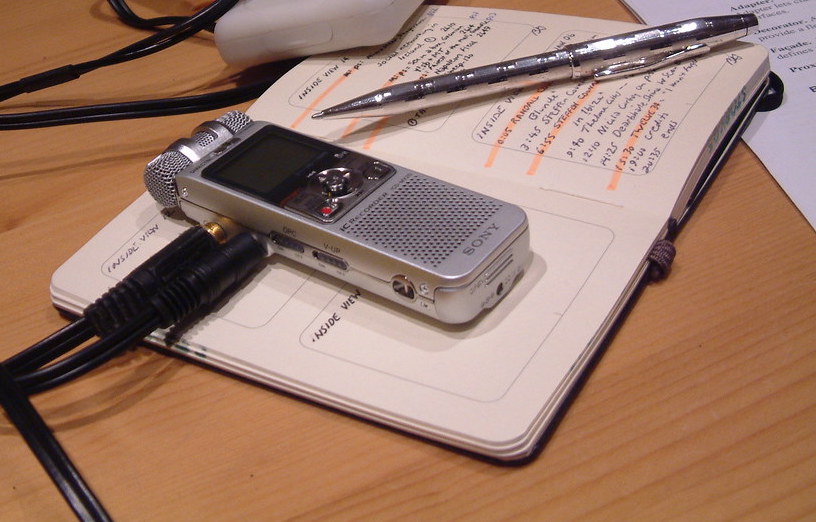
That’s odd, I thought staring at my trusty dictaphone. I didn’t know it had a light. A flashing red one too.
Odd. I could’ve sworn I hit record when interviewing my client’s client for this juicy story of triumph over adversity.
Why aren’t there any audio files after three months ago…?
Shit. This isn’t good. Where’s my magnificent latest interview? The one I really, really need to write up for my client.
Cue terror.
Like a trap door to the guts. Like travelling over a humped bridge at speed. Or a shit rollercoaster.
I feel the earth fall away beneath me.
One horrible day in the life of an over-preparer
When life went according to plan, in a former life as a case study copywriter guy, I’d sketch out a mindmap of topics to ask about, mic up my phone, then capture some bigwig CEO/MD of a faceless corporation’s tall tale of endeavour.
I’d listen, interrogate, and focus entirely on the conversation, safe in the knowledge that my trusty recording apparatus had my back.
When it didn’t, well, as you can see: my arse dropped out.
The origin of presence
In the before-times, long before treacherous recorders, I’d jot notes in hybrid shorthand, frantically trying to keep pace with whatever revelations my interviewee divulged. Yet I soon found my attention drawn disproportionately to keeping a meaningful record of the interview, at the expense of actually holding one.
Thus I came to value the notion of presence: actually being there in the moment with someone, listening for vocal cues, and crafting questions on the fly. This made for far more engaging written articles, based on a livelier, more human interview.
Both my interviewee and I enjoyed the experience more too. I could provoke and tempt emotions out of people (usually men) who made a living from repressing them in the face of challenges.
For the bargain price of just 40 quid, my trusty dictaphone bought me presence.
And I don’t use the word trusty lightly either.
I did invest trust in it. It set me free to be a bit more me.
Then came the fateful time my dictaphone zombified
The tiny electronic charlatan said it was recording, when really it wasn’t. Worse still, it’d kept up this pretence for months without me knowing.
Without any notes I’d lost the bones of a story. Stories.
I’d have to do the interview(s) all over again in a vain attempt to recapture that lost magic.
Unprofessional. Incompetent. And other value judgements ensued.
The extent of hyper-preparation
You’ll be relieved to hear all was not lost.
Because some of us, those of you who think like me, are so hard-coded for failure as an inevitability, we build contingencies for our contingencies. Even with a dictaphone, it turns out I’d still hit record on my smartphone’s voice recorder app.
Almost habitually, unknowingly.
It was genuinely a surprise to discover that.
Makes you wonder, doesn’t it? Did I ever really trust myself? Was I ever really, fully present at the time of recording, if my mind was on contingency and preparation?
You could chase that thought even further. With multiple layers of protection like this, you have to wonder what are we really protecting ourselves from?
Something tells me it’s to do with exposure and vulnerability – being revealed as a less-than-perfect human being, and handling the emotional fallout of, eurgh, failure.
And what would the real cost of failure be? The temporary discomfort of re-recording an interview? A shame-faced admission to a client, who in all likelihood would’ve felt my pain.
Who knows.
Preparation – a way of life?
So there it was. Crackly mono, compressed and whispery, but I had a backup of my backup. The interview was saved. I could work with crap. Crap is better than no crap.
Now, you might think the moral of the story is preparation pays. “Fail to prepare, prepare to fail” goes the wanky business idiom.
I wish it were that simple.
It isn’t.
Preparation runs deeper than that, I suspect. It’s a way of life. It sets a precedent, an expectation, an intention to be hesitant, cautious and restrained. A subtle anxiety, that nibbles away at presence, playfulness and flow state – all crucial ingredients for a delightful conversation or interview.
Or anything joyful and creative too, I suspect.
I wonder. Is there a link between presence, preparation and that kind of authentic, vulnerable state we need to be in to get the best out of ourselves, and the people we’re with?
Could preparation be fear of vulnerability, and presence a way to embrace it?
Let me tell you one last story about preparation
Recently, I’ve been recording a series of interviews with intriguing people, all about their personal philosophies and how they relate to uncertainty, the future and change. I call it the pessimist’s guide to a hopeful future (episodes launch in April 2021, probably).
Despite recording each conversation with every available instrument I have (zoom, dictaphone, smartphone, wax cylinder, mynah bird etc.), the preparer in me still worries about losing something – be it the recording, some wisdom, magic, or a perfect question.
The preparer in me is an inveterate note-taker too. I frantically scribble things down, just in case I forget. Never trust your memory or yourself. It’s another expectation or intention, which on occasion almost encourages my mind to let slip the thread of conversation.
Could it be that preparedness, a kind of control, is at war with presence? Presence says let go of control and sit with things as they are. Preparedness says keep checking for a red light.
We’re approaching the wisdom bit
When gatherings were a thing, my friends at Glug Leeds had me over to talk about being a freelancer in the creative industry. That copywriter thing again. I’ve spoken at a few of their events, always heavily scripting and rehearsing myself, for all but one.
Here’s the interesting thing – my most recent, least scripted talk felt funnier, freer, and more meaningful (at least to me).
Now I’m not saying preparation is bad or good either way, or how much is appropriate. I suppose the subtext here is perhaps it can get the better of us, at the expense of presence?
Is there such a thing as being over-present?
Presence feels like a more fun way to do things, but that alone at the exclusion of doing your homework (preparation) can come at a cost too. It can make you look like an amateur, like you don’t take something seriously. It’d never have washed with those CEOs and MDs I used to interview.
On one memorable occasion I deliberately did little preparation (as an experiment) for an open-mic stand-up comedy gig, and got to a point of such supreme not-giving-a-fuckness that I recall getting up on stage and completely losing it, muttering “so… grandad died” on a loop, unable to recall any of my routines about coal mining and masculinity.
The audience yelled encouragement and felt my pain, but it was too late. I’d already transcended corporeal form, floating several feet above I witnessed myself dying on stage.
I was acutely present, kind of, yet it felt dissociative, like a bad trip.
Questions for preppers
I don’t have the answers here. Perhaps preparedness or presence isn’t a binary choice? Maybe our capacity for both is innate? Could some lean towards one over the other, habitually? Could they even coexist?
Perhaps there comes a point (and maybe I’m reaching it) where decades of perpetual preparedness now qualify me as perpetually prepared, so there’s credit on account that I can invest in presence.
Is this what enlightenment feels like?
Time to throw this over to you, because I’m a coach and that’s what nerks like me do.
Have I prepared these provocative questions beforehand? See if you can tell… I’m certainly very present in writing them:
- What’s your habitual state – present or prepared? At what cost?
- If these states coexist, how do you float along the spectrum when you have an upcoming event or deadline?
- Have you ever been totally present yet totally unprepared (or vice versa) – what happened? What came of it?
- How would you like to be, in an ideal world, when the stakes are high?
- What’s one tiny step you might take, right now, to get closer to that?
Photo credit: “Moleskine iPod Dictaphone” by topgold

The hospitality hack to turn inner house party to inner calm
I’m sat, eyes closed and tuned in. Not to the background drone of ‘Radio Shitchat FM’ here in my coworking space. I’m focused on something far more animated and relentless – the live 24-hour house party that is my mind.
And as I stand in my cranial foyer, red carpet unfurled, metaphorical guests come and go…
- There’s the gung-ho guest kicking chairs over. They’re keen to just get on and write this article you’re reading right now.
- Then there’s the cautious one, all sombre and diligent. They insist we do this properly: ‘let’s plan first’ they say.
- There’s someone yelling ‘give up’ in time with the music. According to them, ‘no one reads this shit anyway, so why bother? It’s difficult and pointless’.
- And over there, shy in the corner sits the quiet and polite guest. They secretly fantasizing that this could be the breakthrough article that invites a watershed of new followers and enquiries for coaching.
Suddenly, other party-goers get wind of this fantasy and the room erupts.
Everyone wants their say on what really happens next. Drinks get spilt, a fight breaks out, and funky new stains appear on the already pockmarked carpet.

Photo by cottonbro on Pexels.com Does your inner world sometimes feel like an illegal rave?
Is there a lot going on up there? Are you living a stream-of-conscious monologue, written while performed in the echo chamber of yourself?
Tune in now to what’s going on inside. Can you sense competing urges, feelings and impulses? Are they noisy, contradicting and sometimes confusing?
This is completely natural, apparently
As Natasha Lythgoe, leader of a recent course in focusing said: “welcome to being human.”
Natasha’s training shared a new model for making sense of this inner world. Rather than a single metaphorical voice dominating the party (which I assumed was just a single, albeit very messy me), it’s possible to discern many voices. A revolving door of characters, loud, quiet and everything in between, all with unique and contradicting motives and messages.
And if you feel carefully enough, apparently, it’s possible to sense real, physical sensations in your body that correlate with those myriad forces within. I believe ‘embodiment’ or ‘befriending’ are other monikers for this so-called art of focusing.
First, a quick disclosure
I’ve only been practising for two months so I’m no expert at this. I’ve meditated for roughly the same number of years so that’s my limited benchmark on matters of the inner world. On that front, I’m fairly spiritually illiterate.
That said, I know the turmoil within intimately. And moving beyond simply coping is what brought me to focusing – not just for me but for the people I coach too.
I also feel compelled to add that, generally, I only do things for utilitarian reasons. It has to work, or otherwise serve some demonstrable, functional purpose. And focusing, so far, seems to deliver on that, with evidence to back it up.
I document my formative experiences here as a signpost for like-minded people looking to experiment with their wellbeing routines. It’s for anyone curious, intrigued by new ways to paddle in the deeper waters of human consciousness.
Welcome to intentionally earthing yourself
As I understand it, the theory goes that by warmly greeting sensations (through focusing), without judging them as good, bad, right or wrong, everyone feels welcome at the mental house party. Restlessness, anger, glee, sadness, lust and the whole spectrum of human feelings are greeted as equals, no questions asked.
Intention seems relevant too. By really really wanting to be present and there for yourself or someone else (we practised as pairs), whoever decides to show up at the party, focusing takes on more significance.
It’s a bit like meditation in that respect: resistance, and wanting things to be different, only cranks up the conflict. So instead, we just sit and welcome it all, as it already is.
Take compulsion and urgency, for example
There’s a part of me forever on-the-go: doing, exercising, building and learning. It feels like a convex tug in my stomach, lurching forwards, as if I’m constantly rising from seated, with restless legs.
It’s not a bad or good thing, just a thing – like all the other urges that come and go.
Focusing suggests that I feel and describe that sensation in my belly. That I greet it with open arms and a warm smile. And like every good host, make sure it (and everyone else) feels right at home.
The premise is that (like a party) no single guest gets to unfairly dominate the evening’s entertainment. And with that you feel more grounded, balanced, centred, or any other number of esoterically mystic states.
I’ve also heard focusing likened to earthing yourself
Now this is a metaphor I can get to grips with, silly blokey human that I am. These thoughts and feelings are like bolts of energy zapping* around us, with nowhere to go.
So by scanning the body and finding out where, physically, the charge is, I give it a point to earth to. Somewhere for the electricity to discharge, safely, without frying anyone.
* = Like all deep inner work, words can elude us, so we’re limited to tenuous analogies and metaphors, the kind littered in this article. I’ve tried to be pragmatic. Give me a break. If you enjoy particularly esoteric descriptions, check out Natasha – the lady who taught me.
Worth having in your toolbox
Focusing is all very well and good when life’s peachy, and you fancy a quick cuddle with yourself. But what happens when you’re triggered? Like when someone breaks your cardinal rule of ‘always do things properly.’ Like turning their car without indicating at a road junction, for example.
It can feel impossible to ignore e.g. Mr/Ms Perfectionist guest. She/He who instantly picks up the cocktail cabinet for a spot of amateur window reglazing, screaming like they’re the only person who matters at the inner party.
Well, I’ve been there, frequently.
It can feel like a betrayal to not indulge the loudest of guests. They’re so loud, after all, so familiar, so they must be right. Maybe they are.
With self-awareness upgraded, I’ve got a new stratagem in my toolbox
Now, I still feel a surge of anger and self-righteousness. But I locate it somewhere physical – in this case, my chest. I recognise whoever turned up, and quietly appreciate what they brought to liven up the party (even if it’s a semi-automatic weapon).
And in welcoming the sensations that manifest physically (tightened jaw, tight belly), I rest assured there’s a worthwhile motive behind the urge. Even if I can’t see it yet. It’s like trying to see the best in a guest, even when they soil your bedsheets.
OK, focusing can be a bit like soothing a toddler sometimes. But perhaps that’s the nature of a particular urge? And respectful, non-judgemental attention is what it needs. Like acknowledging the tantrum, kindly, but not engaging with it.
As an aside, focusing is introducing me to the various characters inside (some of whom I know better than others). I’m discovering more about who they are and gaining clues about who I really am and where to go next.
The hospitality hack
If you’re the type to live life under a microscope (like I do), perhaps you’re intuitively wary of inviting extra introspection into your life, with a practice like focusing.
Rightly so.
Yet it seems the knack to focusing is a shift towards being more welcoming and hospitable to the various motives and impulses of our inner word. We don’t scrutinise the party guests, nor endlessly analyse who they (we) are, or feel bad about them (us) being that way.
Everyone’s welcome. That’s the basic premise. And there’s enough jelly and ice cream to go around.
Similarly, perhaps you’ve come across tiresome positive psychology mantras, encouraging you to be more loving to or accepting of yourself?
It’s fairly ubiquitous advice. But it’s quite vague and impractical too, especially when you’re in the midst of another pernicious mental bun fight.
So what I like most about the focusing model is it hacks an ancient expression of generosity and kindness: hospitality towards fellow travellers. There’s something innate and natural about being kind and welcoming to our guests – that’s a model I can work with.
And anchoring those physical sensations in the body gets you out of your head quicker. So you can get on with the very human act of being kinder and gentler to others like you are to yourself.
“You spotted something amazing and reminded me of the proof”
“Very, very helpful. Like you say on the website this gets you space with someone who gets you – that’s exactly what I was looking for. Someone to get me to think, a fresh and external point of view.”
“Sometimes I say some things that are eye-opening for me but I don’t know I say them until you show me them back.“That’s what I needed. I did not know they were there.
“You spotted something amazing and reminded me of the proof, with a different perspective. That’s what I learned from your coaching.”

An outsiders’ renaissance for irregular humans like us
If you painted a vignette of your formative years, what would it look like? My adolescence is a lanky geek staring out of a bedroom window lamenting the world’s indifference, anticipating myriad traps ready to kill or maim you and the persons you hold dear.
Bleak, I know, but that’s growing up in a northern industrial town for you.
Sometimes the outside world had the temerity to enter my inner one. Like the night Sally and Kerry from school spilled into the front garden of my childhood home with a bunch of scallies. Despite being several rungs up the social ladder, presumably they thought it’d be a laugh to give the neighbourhood hermit a knock.
“Can Kerry use your bog?”
I remember mum answering the door. “There are some girls downstairs to see you, Chris,” she announced, smirking like mums do, skirting gingerly on the periphery of teenage sexual politics. I cringed, then tore myself away from the concocted hysteria of TV’s Robot Wars to investigate.
I met Sally peering around the door, her eyes crossed, reeking of cider. Behind, in the darkened garden, innumerable silhouettes fell about, guffawing and yelping.
“Can Kerry use your bog?” she slurred, using the decorous Widnesian word for toilet.
“Er… Dunno, I can ask.” I replied, unsettled by society’s wanton intrusion.
“Dunt matter,” Sally said, looking over her shoulder into the shadows, “Kerry, you alright?”
“Um, yeah,” came the disembodied reply after an ominous pause, “Ask him for bog roll.”
“What the fuck are those!?” Sally asked, returning from the bushes for a third round of tissues. She was pointing at my feet, sniggering. I wore moccasin slippers – the kind your granny might relax in, ornately stitched pale brown suede, with a fancy leather bow on the front.
Sally got the laugh she was looking for.
I tucked both feet behind a curtain and shrank into the door. Not shy, just fearful of retribution. Widnes championed a complex, fragile relationship between masculinity and attire – one I still don’t understand to this day.
Heaven knows I’m miserable then
This experience, and many others like it, formed an opinion in me that people – popular people (and therefore, by extension, everyone apart from me) were somehow different. They had priorities, motives and means distinct from my own.
And consequently, I was doomed to be an outsider, though partly by choice. I didn’t fancy associating with folk who didn’t customise their hobnobs with squirty cream, study Monty Python songs like gospel, or keep a secret cache of crispy Denise van Outen pics shoved behind their wardrobe.
Looking back, it’s obvious why I was drawn to the Smiths at about the same time hair in uncharted bodily regions became a life goal. What they sang about – the awkward social encounters of a fantasist, acerbic cynicism, and generally feeling very, very sorry for yourself, felt deeply familiar.
It wasn’t their intellectualism and musical prowess (though I’ve come to appreciate that too) it was more what they stood for, embodied by Morissey in particular. Here was a like-minded miserable grump, who felt more deeply than most, to whom life also happened.
In Smiths-era Morissey (pre-jingoistic nationalism) my nascent identity was complete. And I’m not sure I ever grew out of it.
Or that I even want to.
Many cling to outsiderness, do you?
I suspect you’re screaming – that’s all teenagers, Chris! Indeed, some are lucky enough to discover a movement: punk, goth, indie. They scratch the itch and one day grow beyond outsiderness – they find a place, jump on the gravy train, sell-out, or otherwise play by the rules.
Alas, even counter-culture movements were too mainstream for awkward young me. And I suspect there’s a good chunk of other unbelonging outsiders out there who didn’t (can’t? won’t?) transcend outsiderness, making it a recurrent and inescapable theme throughout life.
What about you?
If you feel like you’re perpetually standing on the sidelines, observing others in delight, horror or utter bemusement, as they engage in an increasingly absurd rat-race – then you’re a bit of an outsider too.
Is it your self-reliance, free-thinking, creativity or contrarianism that makes you feel peripheral to conventional ways of living and mainstream culture?
You try not to judge. You know other people are only human like you. But still…
Convention isn’t just mad, it’s toxic
I suppose I’m championing a renaissance in constructive outsiderness. With rampant inequality, greed, social injustice and intolerance all very much (un)civilised and unthinking norms, perhaps these particular conventions are worthy of rebellion?
Let’s not forget inaction on the climate crisis too. There’s another norm worth challenging.
The world’s gone full-Kerry and laid a great big mahogany tod right in the middle of the garden. Staring out of our bedroom windows, environmentally-minded outsiders the world over stare and point in exasperation at said turd, wondering who’ll bear the consequences.
Outsiders have options
The benefit of age (and dare I say it maturity) has taught me a few things about outsiderness. I’ve come to respect the freedom, perspective and opportunity for change it presents.
My take is that outsiderness needn’t mean isolation or loneliness, like it did 25 years ago from my bedroom window. It can actually bring you closer to people, paradoxically.
Outsiders like us have options.
Like all special abilities, great power comes with great responsibility
On a bad day (or year), outsiderness can compel us to seclusion. Until relatively recently I found myself going mad in a basement, renovating our house. The DIY I enjoyed, the feeling that the world kept spinning without me, and I had no place in it… ‘oh no, here we go again,’ I thought, reaching for hobnobs and tattered Denise Van Outen archive.
On a good day, outsiderness can be a lens; helping you thrive amidst the noise. This really helped me as a freelance copywriter. Clients valued my impartiality and the fresh perspective I brought to their world – one I wasn’t a part of. I was paid to call bullshit on their nonsense, and tell-it-like-it-is.
Now it’s emerging as a foundation in my coaching – helping people embrace their inner outsider, to create and occupy a place in the world, and craft a peaceful bridge between where we are now and where we need to be.
Has your outsiderness ever opened doors for you (ideally while not wearing your granny’s slippers)? Maybe people come to you because you see things from the outside in a way they never could.
On an average-sort-of-day, outsiderness can be a handy compass too. It can help us navigate routes through life’s big decisions, intuitively bleating if it notices a wrong turn.
My outsider sat-nav is programmed with a morose Mancunian accent, and a habit of bleating about vegetarianism and awkward sexual encounters on railway property. One doesn’t always have to pay attention to it, after all, there are many routes to the same destination.
Have you ever ignored your outsiders’ intuition and followed the herd? How did that go?
I did once. I cracked in a car park outside Knaresborough, after sleepwalking through four years in the barren grey plains of corporate servitude. Only when I embraced my outsiderness, turning freelance, did I reorient myself to what matters most in life.
Outsiderness is a superpower
Outsiderness needn’t mean feeling sorry for yourself, victimhood, or inevitable loneliness – though it can feel like that when we indulge our inner adolescent, staring out our bedroom windows at a world gone mad (as we all do from time to time).
Have you ever thought to embrace your outsiderness like an intuitive superpower in-waiting? Like a special ability you’ve yet to make the most of.
How might you make yourself, and the way you see the world, indispensable to people too bound up by conventional thinking and mainstream culture (without being subsumed by it)?
What steps have you taken to discover other outsiders, who are also acutely aware the world’s taken a nosedive? If you reached out to them, together might you nudge humanity’s fortunes in a more favourable direction?
Hurry though. Kerry needs the bog again.
Image credit: Gladioli by Verity Cridland

Can’t get motivated? Bad mood? De-escalate, join, tune in
Come, bear witness to the theatrical delight of a poxy magpie pecking a blackbird to death over a measly scrap of bread. And savour the continental ambience of brutal, grey concrete benches, smashed and striated by a thousand joyriders, all cowering under the watchful gaze of tower blocks and antisocial housing.
Welcome to the Grebes housing estate, people – a dilapidated, bin-themed fairground near where I live in Yorkshire, sure to inspire that Monday morning feeling any time of the week. Helplessness, existential dread and lingering despair are never in short supply here. And grebe is a state of mind.
I found myself traipsing morbidly through Grebes estate one morning not all that long ago, en route to the office. The previous day, I’d knowingly avoided all the things I knew I ought to do. And today I’d resolved to get them done: finding and mingling with changemakers I long to serve, as I built my coaching business.
But, like the billion dog eggs bejewelling the Grebes estate road, so many unknowns lay in my path. What problem am I solving? For who? How do I help? Where are they?
And if there’s one thing the mind doesn’t need on a stroll through the Grebes estate, it’s uncertainty. I tried my best to walk purposefully, but that familiar treadmill of doubt span and creaked in my mind, slowing me down.
What began as slight hesitancy soon revolved into full-blown, existential panic. I’d resolved to take action, I just didn’t know what or how. So why bother even trying?
Then, right on cue, came feeling bad for feeling bad
I cowork in a converted flax mill near the Grebes estate, where poor young nippers were literally mangled to death crawling beneath heavy machinery, so that toffs might have more comfortable socks.
Comforting thought, I thought. Now we’ve lost perspective too, and replaced it with post-industrial class guilt.
If you’ve ever built a business from scratch or launched any ambitious project, these feelings might sound familiar. It’s not unusual to feel beaten before you begin, and kicked when you’re down, over and over and over again.
That’s what you get for chasing your dreams, when grit isn’t your forte
I used to cope by diverting my attention to well-defined, achievable tasks, like bleeding a radiator or buying some screws. Until brute force or resignation eventually showed up, forcing me to confront the unavoidable, those tricky tasks, with frustration and disappointment.
These days the stakes are higher for me. While it’s OK to feel what my clients feel, it’s deeply inauthentic to not practice what I preach as a coach – meeting challenges like these with a more helpful attitude.
So this article is my reflection upon new ways of coping and getting motivated. Of how a black day turned grey, then off-white, and eventually yellow. Yellow being good, because it’s kind of warm and sun-coloured like golden sunlight (another colour alien to the Grebes estate).
Maybe they’ll work for you too?
First, de-tangle and de-escalate
When I worked with naughty boys and girls at an inner city school (ineptly I might add), we were taught to de-escalate if a scrap looked imminent. That means bringing heightened emotions down to a manageable level, so our brains act a little less reptilian.
One way to de-escalate alone is by journaling (or morning pages). It doesn’t resolve unknowns, it just downloads them, so they’re out of your head. Doodling or wittering works well too.
Journaling helps identify what’s really going on and what’s really on your mind. It breaks lumpy thoughts into individual nuggets, giving them coherence. With the brain less dark and muddled, threads of ideas and options emerge, like pulling earphones from a cat tod.
On that fateful morning, journaling revealed five or six different themes in my coaching, possible lines of enquiry for the whole ‘who and how do I help’ problem. Too early to answer, but they were jammed in there all the same, throttling valuable CPU time.
Journaling bought relief and space. It was kind of exciting too, to know creativity was in there somewhere. Playfulness was emerging; laughing at the ridiculousness of sipping an oat milk latte inside a former temple to the crushing forces of ruthless capitalism.
How might you step back from the brink, and maybe even enjoy a laugh with yourself?
Second, join something bigger
Coincidentally, I’d applied to join a group called coaches helping coaches a few days earlier. So, after braving the toxic cross-fire that is Facebook, I discovered my membership was approved.
Isn’t it funny how doom halves when you hear others feel equally doomed? Perhaps this works best when we aren’t looking for answers, like how-to explainers. Although we might think we want to be told the right way to do something, what we really need is understanding and connection from others.
I tried that and felt a little better still, as well as empathy and compassion.
Although still unresolved, my concluding remark here is that this business development stuff is tricky as fuck. Yet everyone goes through it, there’s no avoiding it or quick fix.
But could it be that the very thing you’re up against – effort and persistence as a barrier to entry, is what distinguishes you from those who give up?
Third, tune in
With my mood lifted, I had a good hard stare at the canal through a mill window. A grey wagtail balleted purposeful on the frozen water, flashing its yellow underbelly while scrabbling at fags and empty cans of Galahad lager.
Nature is so restorative, isn’t it?
Feeling more objective, I wondered what all this resistance might be telling me. Strong feelings are often signals. Perhaps I was doing too much saying – wanting to rush straight to market with a fully formed idea of the whats, who, hows and whys of business.
So what would listening involve? Asking? Talking? Would that be a more appropriate, agreeable way to connect with people? What would that look like?
After realising I’d just coached myself with some magnificent questions, I resolved that getting into conversation with people as an exercise in market research (“hello what’s your world like? Would you like some help with that?”) is a splendid way to shape a business.
What would it take to lift your mood?
In my experience coaching, when people have calm and perspective, their questions answer themselves. When I felt less defeated and morose after this remedial action, creativity came back online and suggested five specific things I could do to find my kind of people to coach.
That would never have happened, had I let the Grebes estate mentality shape my day.
What’s especially notable is that the three things I put at the heart of coaching others – playfulness, compassion and curiosity, are the very same three things that lifted me out of this particular rut. Who’d have thought?
Maybe there aren’t any boundaries between career, business and life? Perhaps it’s all one big adventure? Perhaps there are clues to what lifts your mood, in what you already give others?
Bum days are inevitable
When you’re in a bleak mood, how might a little less urgency and a little more ‘working up the levels’ towards a more useful state of mind, like I did, help you?
Attitude is the perennial blocker of many, if not all, routes to where you dream of being, and back on the Grebes estate mine was all kinds of wrong. If that dreadful feeling of doubt and inaction is all-too-familiar and all-too-tiresome, then maybe it’s time we worked on new ways of showing up in the world?
Ever had a sluggish start to the day. What happened? How did you recover?
Photo by sunrisesoup